

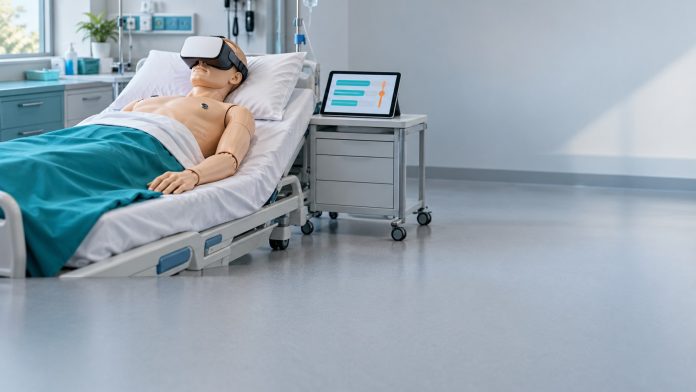
A meta-analysis of 193 trials published in March 2026 found that educational games and gamified courses both improve learning, with effect sizes of 0.87 and 0.75. Virtual reality training for doctors, nurses and technicians shows promise too, but two other reviews published this year, in Sage Open and Frontiers in Medicine, warn that the immersive evidence is thinner than the marketing.
Key facts
- Wei Xu and Wei-Ang Dai pooled 193 randomised or quasi-randomised trials and 1,029 effect sizes in Active Learning in Higher Education (March 2026).
- A Sage Open meta-analysis by Francis Obeng Gyedu and colleagues (February 2026) covered 22 studies and 2,847 students and found a large average gain, with an effect of just 0.09 for 3D VR, role-play and narrative formats.
- A Frontiers in Medicine review from Ningbo University (June 2026) found most virtual simulation studies were small and short-term.
- In Kenya, the PPH School uses VR to retrain health workers in managing childbirth bleeding; its first class had 40 trainees.
What do 193 trials say about game-based learning?
The Xu and Dai study is the broadest recent synthesis. It separates game-based learning, where the lesson is a game, from gamification, where points, badges or leaderboards are added to a normal course. Full games scored higher (d = 0.871) than gamified courses (d = 0.754). Subject area, duration and learner stage all changed the size of the effect.
The smaller Gyedu review in higher education reports a much larger average, d = 1.12. Its own numbers ask for caution. Heterogeneity was 98.84%, a sensitivity analysis gave 0.98, and Egger’s test pointed to publication bias. Competitive game formats came out strongest at 4.18. Courses lasting three months to a semester did best, while interventions longer than a semester dropped to 0.36.
So the two reviews agree on direction and disagree on size. That gap matters to anyone writing a business case.
Where virtual reality training fits
The VR result in the Gyedu review is the striking one. Three-dimensional VR, role-play and narrative approaches together averaged 0.09, close to no effect. The category mixes very different formats and rests on few studies, so the figure says little about headset-based VR on its own.
Clinical training gives a more mixed picture. The Frontiers in Medicine review by Xiwang Jiang, Haichao Ge and Qianyong Wang collects results across specialties. In one surgery study, 90% of VR-trained learners performed the correct osteotomy sequence, against 30% of those trained only with 3D-printed models. In nursing, a blended VR group scored 91.56 on CPR skills against 84.28 for low-fidelity training. In emergency medicine, virtual and in-person simulation showed no significant difference. The authors note missing data on long-term retention and cost.
| Study | Scope | Headline finding | Caveat |
|---|---|---|---|
| Xu and Dai, 2026 | 193 trials | Games d = 0.87; gamification d = 0.75 | Abstract-level detail only |
| Gyedu et al., 2026 | 22 studies, 2,847 students | Overall d = 1.12; VR and narrative 0.09 | Very high heterogeneity, possible bias |
| Jiang et al., 2026 | Narrative review, medicine | Gains in surgery and nursing skills | Small, short-term studies |
A Kenyan test case: childbirth emergencies
Kenya offers a concrete example of VR aimed at a single, high-stakes skill. The PPH School, launched by the End Postpartum Haemorrhage Initiative, uses virtual and extended reality to put community health workers, nurses, clinical officers and doctors through severe bleeding scenarios. “This helps strengthen muscle memory and retention,” Dr Kireki Omanwa, president of the Kenya Obstetrical and Gynaecological Society, told Health Business in May 2026.
Prof Moses Obimbo, who leads the initiative, compared the method to flight simulators, according to The Standard. The death toll the project targets varies by source. The Standard cites Ministry of Health estimates of 5,000 to 6,000 maternal deaths a year; Omanwa gave “almost 4,000.” Neither article reports outcome data from the PPH School so far.
Elsewhere, vendor-linked pilots are common. A UNC-affiliated startup reported that 30 minutes of VR teamwork training improved 90% of observed safety behaviours among surgeons in a 2025 pilot, but the university’s article gives no sample size.
What this means for trainers and L&D teams
- Start with the skill, then pick the format. VR earns its cost for rare, risky procedures that cannot be practised on real patients or machines.
- Prefer short, structured game mechanics over long programmes; the reviews favour weeks or one term.
- Ask suppliers for independent trials, sample sizes and retention data, and check whether the developer funded the study.
- Combine simulation with real supervision and record what each trainee practised, so the skill can be checked later.
- Budget for headsets, maintenance and facilitator time, which most published studies ignore.
For more on this topic, read our earlier pieces on VR teaching at Michigan State and on whether learning should copy TikTok.
FAQ
Does gamification improve learning?
On average, yes. A 2026 meta-analysis of 193 trials found a medium positive effect (d = 0.754), with full educational games doing slightly better.
Is virtual reality training better than traditional simulation?
Sometimes. Surgical and nursing studies show gains, emergency medicine studies show no difference, and most trials are small and short.
What is Kenya’s PPH School?
It is a VR-based programme that retrains Kenyan health workers to manage postpartum haemorrhage, the bleeding that is the largest single cause of maternal deaths in the country.
Sources: Active Learning in Higher Education; Sage Open; Frontiers in Medicine; Health Business; The Standard; UNC.