
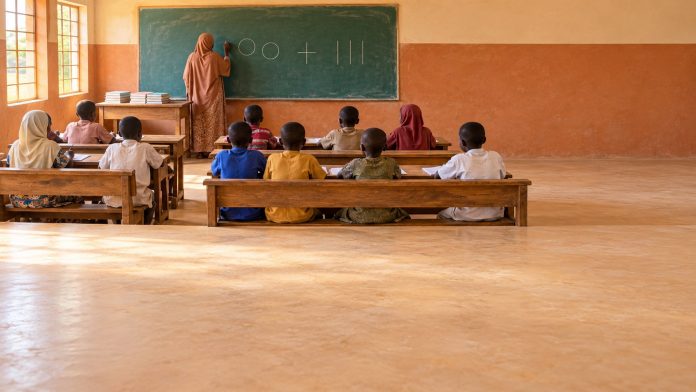
The largest Nigeria basic education programme in years now hinges on state budgets. At a two-day meeting in Abuja reported on 14 and 15 October 2026, Universal Basic Education Commission (UBEC) chief Dr Aisha Garba told state boards that Year 1 of the USD 552.18 million HOPE-EDU programme needs money in their 2027 budgets. For teachers and trainers, the stakes are concrete.
Key facts
- HOPE-EDU is worth USD 552.18 million: a USD 500 million World Bank IDA operation plus USD 52.18 million from the Global Partnership for Education.
- It took effect on 27 February 2026 and targets 29 million children, 500,000 teachers and more than 65,000 public primary schools.
- Money is released against results, so states that miss agreed indicators do not get paid.
- The access component is limited to the 15 states with the largest out-of-school populations.
- Literacy and numeracy teaching will follow a Structured Pedagogy Programme.
What did UBEC tell the states?
Garba spoke to chairmen of the State Universal Basic Education Boards (SUBEBs) at a meeting on implementation readiness, according to Voice of Nigeria and Daily Trust. Her message was blunt. “A lot of the deliverables for Year 1 will require provisions in the States’ 2027 budget,” she said, and she asked chairmen to brief governors and state executives before those budgets close.
That matters because of how the programme pays. HOPE-EDU uses results-based financing, which the Guardian Nigeria described in April as a Program-for-Results model: the World Bank rewards states after they reach agreed targets, rather than advancing funds against plans. A state that budgets nothing for teacher training or classroom construction in 2027 risks producing no results to claim. Coordination runs through several layers, from state ministries and SUBEBs to Local Education Authorities, schools and School-Based Management Committees.
Where the Nigeria basic education money goes
UBEC gave the following split, reported identically by both Nigerian outlets.
| Component | Allocation (USD) | Who can take part |
|---|---|---|
| Education quality | 262.239 million | 33 states, possibly all 36 plus the FCT if they join HOPE-GOV operations |
| Access | 123.9 million | 15 states with the most out-of-school children, subject to other conditions |
| Systems strengthening | 133.611 million | All 36 states and the FCT |
The three lines add up to about USD 519.75 million. Neither report itemises the remaining USD 32 million or so. Planned outputs include 13,000 new classrooms and 10,000 non-formal learning centres.
Two readings of “29 million”
The headline figure has travelled in two forms. The World Bank’s approval release of 31 March 2025 counts 29 million children in public primary schools as beneficiaries. The Guardian Nigeria, covering a Kano briefing in April 2026, presented it as a target for bringing out-of-school children back. Those are very different promises. The World Bank wording is the one in the financing document. Even the name varies: the Bank calls it Hope for Quality Basic Education for All, while UBEC uses Human Capital Opportunities for Prosperity and Equity.
Why teachers sit at the centre of the plan
The quality component is the largest by far, at almost half the total. It funds teacher effectiveness, learning materials and structured pedagogy, an approach that typically pairs teacher lesson guides with matched pupil books and regular coaching for early reading and maths. Half a million teachers would fall under it. Its success will depend on coaches turning up in classrooms after the workshop ends.
The non-formal centres point in a different direction. Ten thousand of them would serve children who have left or never entered school, which often means community facilitators rather than certified teachers. Short, practical facilitator training will be in demand. 3LNews has tracked Nigeria’s reforms at the other end of the system too, from the NUC’s new university programmes to the wider funding questions facing African education.
What this means for educators and trainers
- SUBEB and state ministry staff: cost Year 1 training, coaching visits and materials now, and get them into 2027 budget submissions. Without a line, there is no result to claim.
- Head teachers: check that School-Based Management Committees are active and have records; systems money flows through them.
- Colleges of education and teacher trainers: structured pedagogy needs coaches who can observe and give feedback, a role many in-service programmes do not yet train for.
- NGOs running learning centres: watch which of the 15 access states confirm participation, and prepare facilitator training that can be documented and verified.
FAQ
Is HOPE-EDU a loan or a grant?
The World Bank lists USD 500 million as IDA financing, with USD 52.18 million in co-financing from the Global Partnership for Education. Nigerian reports have often called the whole package a grant.
Which states benefit from Nigeria’s basic education programme?
All 36 states and the FCT can join the systems component. Quality funding is open to 33 states, and access funding to the 15 with the most out-of-school children.
When does the money arrive?
Only after states meet agreed indicators. Garba warned that many Year 1 deliverables require provisions in the 2027 state budgets.
Sources: Voice of Nigeria; Daily Trust via AllAfrica; World Bank; The Guardian Nigeria.