

Universities have spent decades trying to get refugee students to campus. A consortium of African institutions is testing the opposite problem: getting the campus to refugee students.
Kakuma’s been a refugee camp since 1992. Northwestern Kenya. Population’s over 300,000 now. Abdul was a teenager fleeing the Nuba Mountains. Sudan. He’s got a diploma from the University of Nairobi in teacher education. Never left Kakuma. Works for a refugee-led organization there.
The numbers tell part of it. Around 7% of refugees worldwide make it to tertiary education. Barbara Moser-Mercer coordinates the African Higher Education in Emergencies Network and she’s watched scholarship programs pull top students out of camps for years. Brain drain in slow motion. AHEEN tries something different. Accredited university programs delivered straight into displacement settings through digital platforms and local hubs. African universities design the courses—Nairobi, Stellenbosch, Hope Africa in Burundi—and refugees run the learning centers.
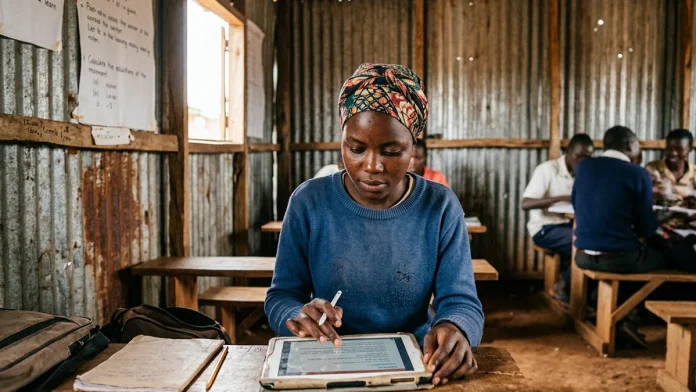
Patrick coordinates one. He’s from Burundi originally, arrived with a diploma and hit a wall. “When you reach the camp, you become stuck,” he said. His organization handles the ground operations now. Physical space, internet, tablets, data bundles. Students work through materials offline mostly. University rigor meets what Moser-Mercer calls local ownership.
The course selection isn’t random. Kakuma needs teachers. Badly. University of Nairobi’s Diploma in Teacher Education in Emergencies went through full Senate approval—same bureaucratic machinery as campus programs. Susan Chepkonga teaches in it. She notes refugees who finished secondary school used to stop there. Just stopped. Now they can work as qualified professionals in camp schools.
Accreditation’s the pivot point. Without it, qualifications stay local and worthless outside the fence. With it, graduates hold credentials that move. Jan Petrus Bosman from Stellenbosch’s Centre for Learning Technologies says this isn’t pandemic-era emergency teaching thrown together in weeks. Lecturers need what he calls “a transformation of the heart, of the head, and of the hand.”
Scholarships go to host communities too, not just refugees. Sounds small until you think about the friction displacement creates in counties already stretched thin. Abdul studied with Kenyan students from underserved areas. Chepkonga describes training faculty in trauma-sensitive approaches because many students grew up in insecurity.
The underlying precarity hasn’t shifted. Food assistance in Kakuma’s been cut. Policy changes tighten household pressure. But the infrastructure changed. Moser-Mercer explicitly rejects what she terms the “parachute” model—Northern institutions dropping courses into contexts they barely understand, then vanishing.
AHEEN positions African universities up front. City University of Mogadishu’s in the network. University of Juba in South Sudan. Programs include community interpreting, disaster risk management, information technology.
Kakuma once received the Lost Boys of Sudan—thousands of kids who crossed borders looking for safety. Three decades on, some of their successors hold nationally recognized diplomas and earn salaries. The camp remains a camp. But the ceiling broke.