

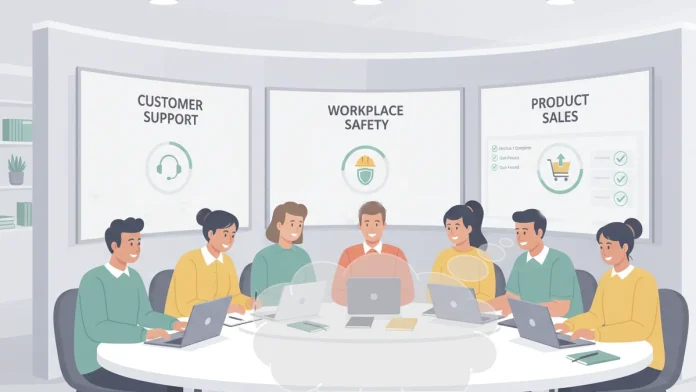
Spend some time in today’s classrooms, corporate training rooms, or online courses and you start to see the shift. Slides are lighter on theory. The emphasis is on what people can actually do when it’s over. Nothing lofty. Just practical skills: handle a customer complaint without escalating it, log a sale properly, catch a safety issue before it turns into paperwork.
This is where learning objectives have moved from being background paperwork to something closer to a shared reference point. Trainers use them to plan. Learners use them to stay oriented. Managers use them to justify why a course exists at all.
On paper, learning objectives sound simple. They describe what someone should know or understand after a lesson. In reality, they’ve become a response to a familiar frustration. Too much training feels busy but hollow. People sit through it, pass a quiz, then return to work unchanged.
In workplaces especially, patience for that kind of training is thinning. Budgets are tighter. Time is scarce. There’s a growing expectation that learning should connect directly to performance. Objectives help set that expectation early. They signal that this is not just content delivery. There’s a destination.
What’s interesting is how often objectives now get paired with something else: outcomes. Outcomes are where the promises meet reality. They show up later, usually in numbers or observable behavior. Did customer satisfaction rise? Did errors fall? Are people actually using the system they were trained on?
The distinction matters more than it used to. Objectives guide the journey. Outcomes prove it happened. Many organizations learned this the hard way. They invested in well-designed courses with clear goals, only to discover that nothing measurable changed. The training wasn’t wrong, exactly. It just wasn’t anchored to how success would be judged.
On the ground, this has led to subtle changes in how courses are built.Content is being cut back with more intention. Activities are picked because they reflect real work, not because they look good in a presentation. Assessments feel closer to practice runs than traditional tests.
For learners, this shift can be a relief. Clear objectives remove some of the guesswork. You know what’s expected. You know what matters. At the same time, outcomes raise the stakes. It’s no longer enough to complete a module. You’re expected to show that it changed something.
There’s also pressure on institutions and training providers. Outcomes are harder to fake. They expose weak assumptions. If a course claims to improve performance but nothing improves, the gap becomes visible.
That visibility is why regulators, auditors, and accreditation bodies care so much about outcomes. They want evidence, not intentions. Objectives help explain why a program exists. Outcomes justify keeping it.
None of this means learning has become mechanical. If anything, it has become more honest. The quiet question behind every course is now harder to avoid: what should change because of this?
As education and training continue to adapt to faster work cycles and tighter accountability, objectives and outcomes are likely to stay paired. One without the other feels incomplete. The plan matters. But so does the proof.