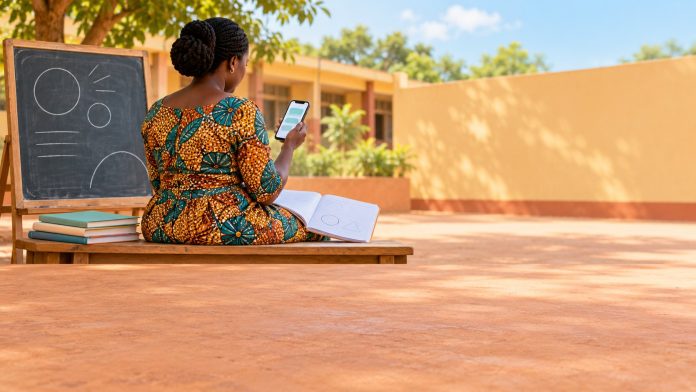
In Bertoua, eastern Cameroon, 55 primary school teachers spent a week in September 2025 learning through short WhatsApp modules of about 30 minutes a day, and rated the chat format easier to use than an online form. The study, accepted at the AIED 2026 conference, is a compact case for mobile learning in Africa: familiar apps help, data costs hurt.
Key facts
- Researchers from Saarland University (Germany) and the NGO B2THEWORLD delivered teacher training through a menu-based WhatsApp chatbot in English and French.
- Teachers scored the chatbot 7.82 for usability against 7.33 for an online form; 87.5% owned a smartphone and 77.1% used WhatsApp daily.
- Youth Impact’s phone tutoring trials in five countries, covering more than 16,000 children, raised numeracy by 0.33 standard deviations at about USD 12 per child.
- In sub-Saharan Africa, only about a quarter of people used mobile internet in 2024, according to GSMA data, even though most live under network coverage.
What happened in Bertoua?
The design was deliberately modest. Vikram Kamath Cannanure and Ingmar Weber of Saarland University, working with B2THEWORLD and the start-up Chatac.ai, built scripted micro-modules on classroom management and play-based learning. Each module offered a short piece of content, an example and a reflection prompt. Language models helped draft the material, but an NGO facilitator reviewed every output before teachers saw it.
Forty-seven teachers completed the survey, 39 of them women. Usability was significantly higher for the chatbot. Learnability was not. In interviews, teachers liked that WhatsApp needed no new login and that content arrived in small steps. They also named the obstacles plainly: weak connectivity, prepaid data, rigid menus and English-only material that left some Francophone colleagues behind, even though 39.6% said they were more comfortable in French.
Does learning by phone actually raise results?
The strongest African evidence comes from Botswana. During the Covid-19 school closures, the NGO Youth Impact tutored primary pupils in maths by phone; the trial, published in Nature Human Behaviour, found gains of up to 0.12 standard deviations. Replications in Kenya, Uganda, India, Nepal and the Philippines followed.
| Format | Result in multi-country trials | Notes |
|---|---|---|
| Live phone tutorial (20 minutes) | 0.33 standard deviations on average; 65% increase in students mastering division | Positive in all five trials; about USD 12 per child |
| One-way SMS only | Mixed; small gains only in the Philippines and Uganda | Worked mainly where no other learning option existed |
Noam Angrist, one of the researchers, summarised the cost-effectiveness as nearly four years of high-quality schooling per USD 100 spent. Government teachers in Nepal and the Philippines delivered results as good as NGO staff. That matters for scale.
The pattern is clear. A human voice on the line works better than a broadcast message.
Why is mobile learning in Africa still held back?
Coverage is no longer the main barrier. GSMA figures reported by TechAfrica News show the coverage gap in sub-Saharan Africa fell to 10% in 2024, while the usage gap reached 65%, roughly 790 million people who live under a broadband signal but do not use mobile internet. An entry-level smartphone cost the poorest 20% of the population 87% of their monthly income. Six in ten users still relied on 3G smartphones or feature phones. Globally, GSMA Director General Vivek Badrinath argued that a USD 30 device could make handsets affordable for up to 1.6 billion people.
For designers, the arithmetic is simple. Lightweight text, voice notes and USSD menus reach more learners than video.
Lessons for corporate microlearning
Companies running microlearning for field staff, sales teams or health workers face the same trade-offs. Short modules inside a messaging app reduce friction. But they need a feedback loop, such as a reflection prompt, a quick quiz or a call with a coach, or completion turns into passive scrolling. For a wider view, see our report on microlearning at work.
What this means for educators and trainers
Start with the channel people already open every day, which in much of Africa means WhatsApp or SMS. Keep each unit under ten minutes and end it with a task the learner does in class or on the job. Budget for data bundles or zero-rated content; otherwise you are asking learners to pay to attend. Offer every module in the languages your audience actually uses. Where results matter, add a human touchpoint: the Youth Impact trials suggest a short live call beats any number of one-way texts. Finally, record what people complete so the learning can count toward a recognised credential, a theme we covered in mobile training for the workforce.
FAQ
Is WhatsApp effective for teacher training?
Early evidence from Cameroon shows teachers find it easier to use than online forms, but the study measured experience over one week, not long-term learning outcomes.
Does SMS learning improve test scores?
Results are mixed. In Youth Impact’s trials, SMS alone helped only in the Philippines and Uganda, while live phone tutoring improved numeracy everywhere it was tested.
What is the biggest barrier to mobile learning in Africa?
Cost and use, not coverage: in 2024, 65% of people in sub-Saharan Africa lived under mobile broadband coverage without using mobile internet.
Sources: Cannanure et al., Teacher Professional Development on WhatsApp (arXiv); Youth Impact; Springer Nature, Behind the Paper; GSMA; TechAfrica News.