
Kenya enrolled 165,552 people in adult education in 2025, up 18.8% in a year, according to the Kenya National Bureau of Statistics. Nigeria now counts more than 8,000 adult learning centres and in one Zambian district seven in ten adult learners are women. For adult education in Africa, the numbers are moving. The harder part is what learners can do with the certificate.
Key facts
- Kenya’s Economic Survey 2026 reports 165,552 adult learners in 2025; women made up 61.2% of them.
- Kenyan officials say 5,220 adult education centres operate nationwide and 15,241 learners qualified for proficiency certificates this year.
- Nigeria’s National Commission for Mass Literacy, Adult and Non-Formal Education (NMEC) reports over 8,000 learning centres serving fewer than one million learners.
- At least 739 million young people and adults worldwide lacked basic literacy skills in 2024, as UNESCO marked the 60th International Literacy Day on 8 September 2026.
Who is coming back to class?
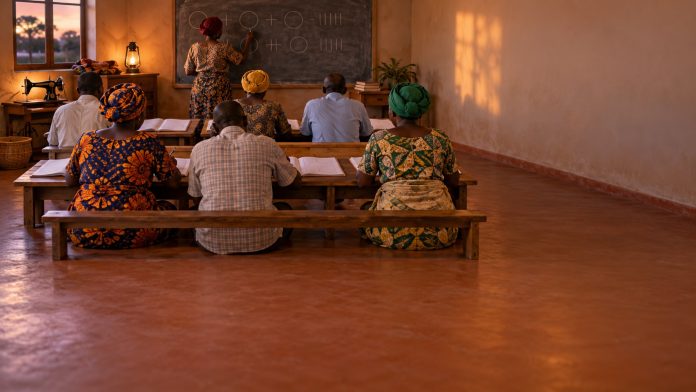
Mostly women. The KNBS figures, reported by The Star on 4 May 2026, show women at 61.2% of Kenya’s adult learners. In Kaoma District, western Zambia, 622 of the 882 adults enrolled across 50 centres are women, according to the Lusaka Times. They study literacy and numeracy alongside agriculture, carpentry and tailoring under the government’s Youth and Adult Literacy Education programme.
Geography is uneven. Nairobi alone accounts for 34,506 learners, followed by Turkana with 11,523 and Nakuru with 10,600. Narok went the other way, falling from 4,900 learners in 2024 to 1,639 in 2025. National averages hide drops like that.
The individual stories explain why programmes keep their budgets. At Murang’a County’s International Literacy Day event in September 2026, the story told was that of Muchoki Maina, who sat his primary exam in 2000, could not afford secondary school, returned through adult education and joined Murang’a University of Technology after scoring 47 points in 2023. Boniface Sitima, the county director for adult and continuing education, called the programme “a second chance to people who missed formal education.”
Kenya, Nigeria and Zambia side by side
| Country | Latest figure | Model | Source |
|---|---|---|---|
| Kenya | 165,552 learners (2025), 5,220 centres | Basic literacy, post-literacy and adult community secondary schools | KNBS Economic Survey 2026; State Department for Social Protection |
| Nigeria | 8,000+ centres, under 1 million learners | Literacy combined with vocational skills and starter packs | NMEC, May 2026 |
| Zambia (Kaoma District) | 882 learners in 50 centres | Literacy, numeracy and trade skills | District education office, July 2026 |
Nigeria’s scale problem
Nigeria’s gap is of another order. When NMEC launched its Accelerated Basic Education programme in Abuja in July 2025, it cited National Bureau of Statistics estimates of nearly 80 million non-literate Nigerians, about 31% of the population. Against that, fewer than one million learners in centres is a start. In a May 2026 interview with the News Agency of Nigeria, NMEC’s Director of Literacy and Development, Dr John Edeh, said the commission hoped to bring back 50,000 to 100,000 more learners within six months, and that graduates choosing vocational training would receive starter packs.
Why adult education in Africa needs more than a final certificate
Kenya’s 15,241 proficiency certificates matter because they connect adult classes to the formal system. Maina’s path ran from basic literacy to the national secondary exam to university. Most adult learners will not take that route. They need records that an employer, a cooperative or a TVET college will accept for shorter steps: a numeracy module, a tailoring course, a basic digital skills class.
Kenyan officials listed their own priorities at the Murang’a event: a revised adult curriculum, materials in local languages, more community learning centres, and teaching of digital and financial literacy. Each of those raises the same question for providers. How will learning that happens outside a school building be documented and recognised?
What this means for educators and trainers
- Design for women’s schedules. With women at roughly six in ten learners in Kenya and seven in ten in Kaoma, timing, childcare and proximity decide attendance.
- Pair literacy with income. Nigeria and Zambia both attach trade skills to reading classes. TVET colleges can offer short modules inside adult centres.
- Record every step. Issue a dated, specific record for each module, not just a final certificate, so learners can show progress to employers or colleges.
- Watch the outliers. Narok’s collapse is a warning. County and district data should be reviewed every term, not once a year.
Related on 3LNews: Lisbon Bets on Lifelong Learning as It Joins UNESCO Network and Mexico Tries to Redefine Lifelong Learning.
FAQ
How many adults are in adult education in Kenya?
The KNBS Economic Survey 2026 counts 165,552 learners in 2025, an 18.8% rise on the previous year.
What was the 2026 International Literacy Day theme?
“Literacy for people, the planet and prosperity.” The global celebration took place in Mexico on 8 and 9 September 2026.
Who runs adult literacy in Nigeria?
The National Commission for Mass Literacy, Adult and Non-Formal Education (NMEC), which reports more than 8,000 learning centres across the 36 states and the FCT.
Sources: The Star (KNBS Economic Survey 2026); Kenya News Agency, Murang’a; News Agency of Nigeria; Vanguard; Lusaka Times; University of Padova Human Rights Centre; ANS / Salesian Bulletin.