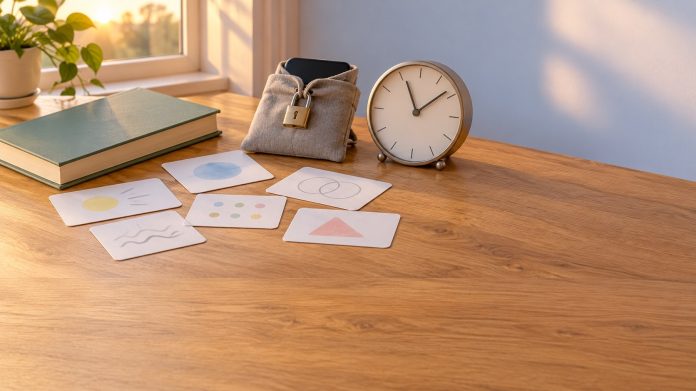
A Swiss school that let pupils start later gave them about 45 extra minutes of sleep a night, while a US study of roughly 4,600 schools found phone bans barely moved test scores. Together with a decade of classroom trials on retrieval practice, the 2026 research on study techniques gives teachers and students a clearer, and sometimes surprising, set of priorities.
Key facts
- At Gossau upper secondary school in St. Gallen, 95% of pupils chose a later start, and school-day sleep rose by about 45 minutes, University of Zurich researchers reported in February 2026.
- A National Bureau of Economic Research working paper from May 2026 found that locking phones away cut in-class use from 61% to 13% of students, with test-score effects “consistently close to zero” over three years.
- A Dutch government survey of 317 secondary schools found about three in four reported better concentration after the national classroom phone ban.
- A systematic review of 50 classroom experiments with more than 5,000 students found retrieval practice benefits learning, with 57% of effects medium or large.
Sleep: the study habit nobody schedules
The Zurich team, led by Joëlle Albrecht with developmental paediatrician Oskar Jenni and Reto Huber, surveyed pupils with an average age of 14 before and after their school replaced a 7:20 start with a flexible model. Pupils could still arrive at 7:30 for optional modules. Few did. Start times moved about 38 minutes later and wake-up times about 40 minutes later, according to the UZH release on the paper in the Journal of Adolescent Health.
Pupils reported fewer problems falling asleep and a better health-related quality of life, and English and maths results improved against cantonal tests, ScienceDaily reported. There was no control group, so the grade gains need caution. Jenni’s warning is the useful part for families: chronic sleep loss “has a measurable impact on mental health.”
Do phone bans improve grades?
Less than many hoped. The NBER study, co-led by Stanford economist Thomas Dee with researchers from Duke, Michigan and Pennsylvania, used data from Yondr lockable pouches. According to NBC, suspensions rose about 16% in the first year before fading, and well-being dipped at first, then rose above baseline by year three. Dee called the academic results “sobering.” Axios also found little evidence of effects on attendance or attention.
Europe tells a slightly different story. In the Netherlands, about one-third of the 317 secondary schools surveyed saw better academic performance, and nearly two-thirds a better social climate, Reuters reported. That survey asked schools for their impressions; the US study measured scores. Both can be true. Removing phones calms a classroom, but it does not teach anyone how to study.
| Study | Place | Sample | Main result |
|---|---|---|---|
| NBER, Dee et al. (2026) | United States | About 4,600 schools | Phone use down sharply; test scores near zero change |
| Dutch government survey (2025) | Netherlands | 317 secondary schools | 75% report better focus; one-third better results |
| Albrecht et al. (2026) | Switzerland | 754 responses | About 45 minutes more sleep per school night |
| Agarwal et al. (2021) | Mostly US and Western Europe | 50 experiments, 5,000+ students | Retrieval practice helps in nearly all conditions |
Retrieval practice: the best-tested of all study techniques
If one habit deserves time on a school timetable, it is pulling information out of memory instead of rereading it. Pooja Agarwal and colleagues screened nearly 2,000 abstracts for their 2021 review in Educational Psychology Review, summarised on RetrievalPractice.org. Quizzes, flashcards and brain dumps all worked, and the authors found no single best format or timing. An earlier study by the same group, with more than 1,400 US middle and high school students, found 72% said retrieval practice made them less nervous before exams.
The evidence has a geography problem. Only 3 of the 50 experiments came from outside the US and Western Europe, in Taiwan, Turkey and Pakistan, TeacherToolkit noted. None came from African classrooms, where classes are often far larger than in the trials. That is an open invitation for universities and teacher colleges in Nairobi, Accra or Addis Ababa.
What this means for teachers and students
- Start lessons with a five-minute, low-stakes quiz on last week’s content. No marks needed.
- Teach students to close the book and write what they remember before checking.
- Talk to families about sleep before exam periods; late-night revision often costs more than it gives.
- Treat a phone policy as a classroom-climate measure, and pair it with explicit teaching of study habits.
- In large classes, use paper slips or mobile polls so every student retrieves, including the slowest writers.
We have covered related ground in Australia’s smartphone ban data and in why studying slips when mental health suffers.
FAQ
Which study techniques have the strongest evidence?
Retrieval practice, meaning quizzes, flashcards or any task that makes students recall information from memory instead of rereading notes, has the most classroom trials behind it.
Do school phone bans raise test scores?
The largest US study so far found effects close to zero over three years, although schools in the Netherlands reported better concentration.
How much sleep did later school starts add in Switzerland?
About 45 minutes per school night, according to University of Zurich researchers studying 754 pupil responses.
Sources: University of Zurich; ScienceDaily; NBC; Axios; Reuters via Malay Mail; RetrievalPractice.org; Evidence Based Education.