

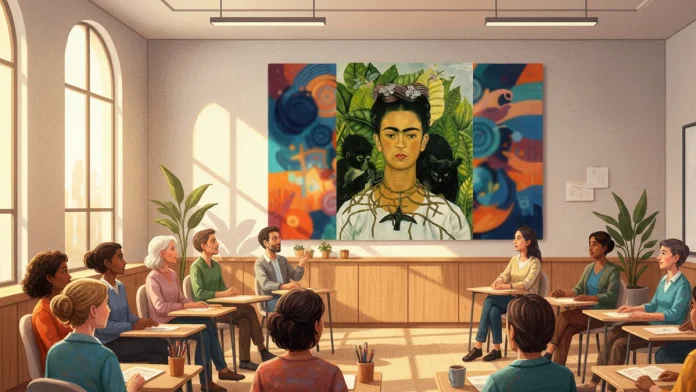
The idea that art and language do not go together is not true. Art is a part of language. It is helpful to students.
Art can be used to teach language in a way. It is not about reading and writing.
- Art helps students to express themselves in a way
- It makes learning more enjoyable for students
- Art is a way to learn about different cultures
Art is an important part of language classrooms. It should not be forgotten. Language teachers are starting to use art. This is a change. Art and language are connected. They should be taught together. The paintbrush is a tool, in the language classroom. Do not put it down.
If you walk into some language classrooms today you will see something that you do not expect to see on the wall. It is not a list of grammar rules or a list of words. You will see a painting. The painting might be the one where people are sitting in a diner at night made by the artist Hopper.. It might be a painting of Frida Kahlo, where she is looking straight at you. The teacher does not start the lesson by talking about the rules of language. The lesson starts with the language teacher asking a question about the painting: what is happening in this picture the language classroom asks, what is going on here with the people, in the painting.
Teachers say that this change is not about making the lessons look nicer. It is actually about getting the students to talk to each other about the lessons. Teachers want people to discuss the lessons and share their thoughts, about the lessons.
Classrooms are getting more international. People are losing focus easily. So teachers are trying to find ways to make learning a language more fun. Art is a way to do this. One picture can get students of all levels talking together. For example a beginner who is at A1 level might say that the woman in the picture looks sad. Someone who is better at the language might say that the woman probably feels lonely because the background of the picture is dark. They are both looking at the picture and learning the language at the same time. The language classes are using art like this to help students, like the beginners and the advanced learners to build their language skills together.
Many teachers use a method. They show the students a picture. Then they ask the students what is going on in the picture. The teachers also ask the students what makes them think that. They ask the students what they can find in the picture.
The teachers do not give talks about the history of art. They do not tell the students what the right answers are and write them on the board. The teacher just gives the students a push listens to what they have to say and sometimes repeats what they said in different words. The conversation is really between the students themselves the art students lead the conversation the art students have control, over the conversation the art conversation belongs to the art students.
When you are in a classroom this really changes the energy in the room. Students who get really nervous during grammar drills often speak a lot freely when they are describing a face or trying to guess a story, behind a scene. They are not trying to find the tense. They are trying to make sense of something that’s human something that they can relate to. The fact that they really want to understand this thing helps the students to speak freely. This is because they are dealing with something that’s real like a face or a scene and they want to figure out what is going on. This makes them want to talk more.
This makes things more equal. When you have people of ages or from different places together nobody needs to be an expert to see a shadow or a movement. A retired person and a teenager can look at the picture and have different thoughts, about it and they can both be correct. This common ground is really important especially when adults are learning things and might not feel very sure of themselves.
There is something going on with language too. We remember language better when we feel something about it. For example a dark sky or a person who looks worried can help us remember things. Even something weird like an apple floating in front of someones face can stick in our minds. The words we learn with these pictures also stick in our minds. Teachers say that students are often surprised at how language they already know when they do not feel so much pressure. Language is, like this because it is tied to how we feel and things that are tied to our emotionsre easier to remember.
This way of doing things is not new. It seems like it is really needed now. When schools have to be careful, with money and students are all different things that can be used by everyone are really helpful. One picture can be talked about for a hour without needing any extra work to be done.
Art is not going to take the place of textbooks. It should not do that either.. People are starting to use images in language classes again and that tells us something simple. People learn to speak because they want to say something. A painting gives them a reason to want to say something, about the painting. The painting is what gets them to want to talk.
And maybe that’s the point. You don’t need to be an art expert to describe what you see. You just need the space to try.