

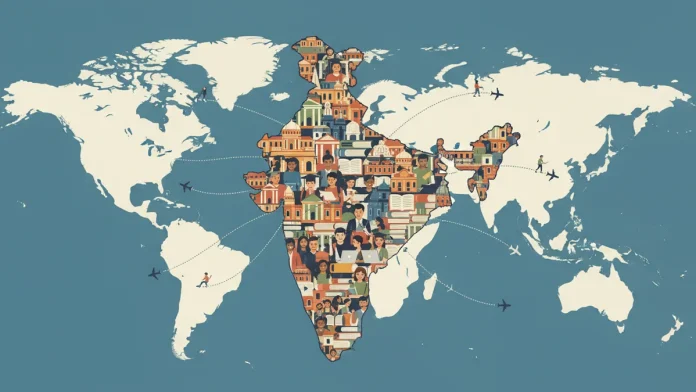
For years, the rhythm has been familiar. Every summer, airports across India fill with students heading to the US, the UK, Australia or Canada. Suitcases, student visas, hopeful parents. Going abroad became a marker of ambition, sometimes even success. Now, a new government-backed report is quietly suggesting that this one-way flow has gone too far.
Published by NITI Aayog, the report argues that India can no longer afford to be just a supplier of global talent. The numbers make the point bluntly. More than 1.3 million Indian students leave the country each year. Fewer than 50,000 international students come in. On the ground, that imbalance feels less abstract than it sounds. It shows up in drained savings, rising demand for overseas degrees, and campuses at home that rarely feel truly international.
What’s changing is not only India’s thinking, but the global context around it. Traditional study destinations are tightening visas. Costs are climbing fast. Geopolitics has made long-term mobility feel fragile. For students watching this unfold, the certainty that studying abroad equals opportunity no longer feels as solid as it once did.
The report leans into that moment. Instead of pushing more students outward, it imagines a system where global exposure happens inside Indian universities. Visiting faculty. Joint degrees. Foreign campuses embedded locally. Classrooms where international students are not a novelty but part of everyday life. The phrase used is “internationalisation at home,” but on campus it would look simpler: different accents in seminars, shared projects across borders, fewer reasons to leave just to feel global.
There is a practical edge to this ambition. India’s strengths are well known. English-medium instruction. Scale. Strong reputations in engineering, management and technology. Costs that remain far lower than Western systems. But anyone who works inside universities also knows the gaps. Bureaucratic hurdles. Limited research funding. Patchy global visibility. For international students, the experience can still feel uneven once they arrive.
That tension runs through the report. It sets bold targets, like hosting 100,000 international students by 2030 and welcoming more foreign branch campuses. It talks about scholarships, smoother visas, alumni networks, clearer pathways for faculty exchange. But it also admits that intent alone won’t change habits built over decades.
On campuses, reactions are mixed but attentive. Some see opportunity. International students could stabilise finances, diversify classrooms and keep Indian talent closer to home. Others worry about uneven benefits, with elite institutions gaining first while regional universities struggle to keep up. There is also quiet scepticism about whether reforms will move fast enough to matter.
What feels different this time is timing. Families are questioning the cost of overseas education more openly. Students are less certain that leaving is the only way forward. Employers care more about skills than postal codes. In that context, the idea of global education without global relocation suddenly sounds less idealistic and more practical.
India’s push to become a talent magnet is not about closing doors. Students will still go abroad. They should. But the report suggests that staying could also become a serious, respected choice. Whether that happens will depend less on policy language and more on lived experience: classrooms that feel connected to the world, research that travels, degrees that carry weight beyond borders.
For now, the suitcases are still packing. But for the first time in a while, the question on campus is not just where students are going, but who might soon be coming instead.