

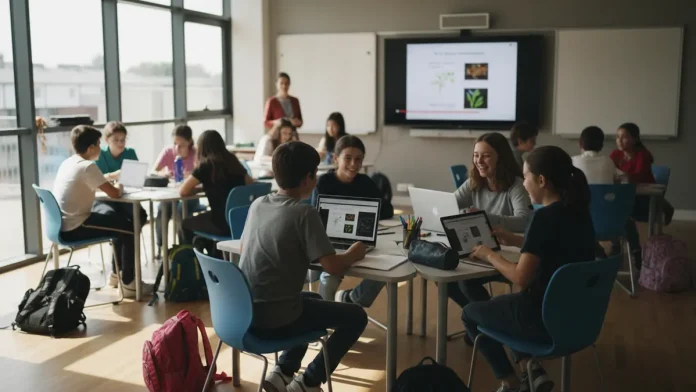
Walk into a modern classroom or corporate training room today and it rarely feels quiet. A short video is playing on one screen. Someone nearby is scribbling notes on a tablet. A group in the corner is talking through a problem, hands moving as much as their voices. It can look chaotic, especially to anyone raised on lectures and notebooks. But for many students and workers, this mix now feels normal. Even necessary.
What’s happening is less a sudden shift than a slow accumulation. Teachers, trainers, and platform designers have been layering methods on top of one another for years. Show it. Say it. Let people try it. Repeat. The idea is simple, almost obvious, but its timing matters. Education is under pressure right now. Attention is thinner. Class sizes are uneven. Online learning is no longer optional. And learners are tired of being talked at.
On the ground, this shows up in small ways. A math teacher pauses a lesson to sketch a problem instead of explaining it again. A university course replaces one long reading with a mix of a short article, a diagram, and a short discussion. In workplace training, a safety module now includes a simulation where mistakes don’t cost anything except a few minutes of retrying. People aren’t necessarily learning faster. They’re staying with the material longer.
There’s also a quiet emotional layer to this. For students who’ve spent years feeling “bad at school,” being offered more than one way in can feel like relief. Not everyone struggles in the same place. Some lose the thread when words pile up. Others drift when things stay abstract. When learning includes movement, visuals, sound, and time to apply ideas, fewer people feel singled out by their confusion.
Technology has accelerated this, but it didn’t invent it. Video platforms, interactive quizzes, and simulations simply made it easier to combine formats without extra labor. A teacher no longer needs special equipment to demonstrate a process visually. A trainer doesn’t have to stage a physical exercise to let someone practice decision-making. These tools fill gaps that time and space used to limit.
Still, the shift isn’t seamless. Some educators worry that variety becomes noise. Others point out that mixing formats doesn’t automatically make content meaningful. Students notice when activities are added just to feel modern. Engagement drops fast when interaction feels fake.
Yet, talk to learners themselves and the mood is mostly pragmatic. They’re not asking for entertainment. They want clarity. They want a second angle when the first doesn’t land. They want permission to learn without pretending that one method works for everyone, every time.
As education keeps stretching across classrooms, screens, kitchens, and commutes, this blended approach may stop feeling like a strategy at all. It may just become the background rhythm of learning. Not polished. Not perfect. But flexible enough to let more people stay in the room, even when the lesson gets hard.