
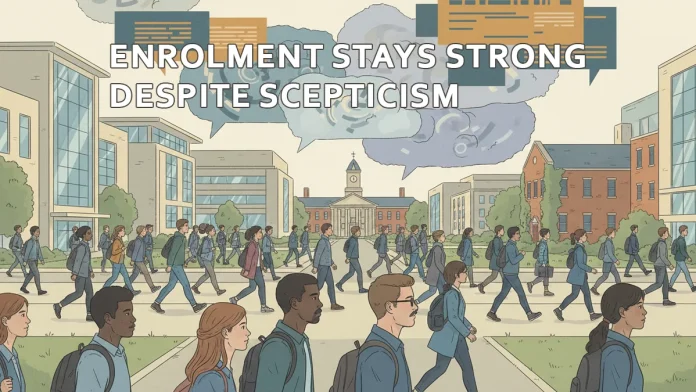
People have a lot of questions about college. The demand for college is not as loud. It is still getting bigger. College doubts are really loud. At the time the demand, for college is quieter and it is still growing.
If you spend a minutes on the internet you will notice what people think about universities. There are lots of headlines that ask if tuition is too expensive. You can even see talk shows that make fun of student debt. Politicians are always arguing about whether. Not getting a university degree is still a good idea. In countries people are criticizing universities saying they are too big do not care about students or that university degrees are not worth the money you have to pay for them. Universities are a thing for people to complain about.
Something just does not seem right to me. The things I am seeing do not really add up. Something, about this situation is not lining up the way it should.
People are still signing up for education no matter what people are saying. Families are finding ways to make it work even if it means spending money than they can really afford. Governments are still building universities and including them in their plans for the economy. A lot of people are questioning if higher education is really worth it. At the same time a lot of people are still wanting to get a higher education. The difference between what people say about education and what they actually do is really big. Higher education is still, in demand and people are still enrolling in education programs.
When you think about it people are saying one thing. Doing another. For example parents will talk about how expensive university’s when they are sitting at the kitchen table but then they will help their kids fill out the application forms. Students will say that having a degree is not that important it is a piece of paper but at the same time they will worry about which university programme will help them get a good job. Even people who do not think university is an idea will still want their own kids to go. University is something that people question in theory. When it comes down to it the choices they make are based on what they think is best for their own family. The university doubt is something that people think about in general. The decisions they make about university are personal decisions, about the university.
The tension is because of how people talk about the value of higher education these days. The conversation has become very limited. People mostly judge degrees by how money you can make right away: your first salary, how much debt you have and how quickly you get a job. These things are important especially since the cost of education keeps going up.. They do not show why higher education is still attractive, to people. Higher education is still something that pulls people in.
For students a degree is not about becoming wealthy. It is about being able to pay the bills and stay afloat. When the job market is uncertain education feels like a safety net that protects students from falling. It is not a promise that everything will be okay. It is a buffer that helps. A degree is a way to keep options open when industries change or job opportunities become scarce. The idea that education helps is still true even if it does not always lead to a paying job and that is why the importance of a degree does not disappear just because the financial benefits of a degree are not always the same for every student, with a degree.
The experience is really different for each person. It depends on where you go to school. For some subjects you can see the benefits clearly. For subjects it takes a long time to see the benefits or it is not clear if you will get any benefits at all. The name of the school you go to matters a lot now. When you finish school also matters. It feels very different to finish school when the economy is doing well compared to when the economy’s not doing well. This is why some students get frustrated, especially the students who did everything they were supposed to do and still have a time. The experience of studying varies a lot from one person to another and from one school, to another.
At the time degrees still matter in ways that people do not really think about. When companies get lots of applications they use degrees to narrow it down. Some jobs, like doctors and lawyers still need degrees. People also expect you to have a degree. In places having a degree is connected to how people see you, who you know and being safe in the long run not just how much money you make. Degrees still carry weight in societies and people use them to figure out if you are a good candidate for a job or if you will be successful. Degrees are important, for getting a job and having a good life and that is why people still care about them.
This is why people are still not giving up on education even when they have doubts about it. People are not saying no to education. They are saying no to the risks that come with it. In the few decades the risk of education has been put more and more on the students. The cost of tuition is going up faster than what people’re earning. The government is giving money to schools. If something goes wrong the students have to deal with the problems. This changes the way people talk about education even if it does not change what they actually do. Higher education is still important. The risks of higher education are what people are worried, about.
The media is very important in this. They usually talk about the things that can happen: people having a lot of debt jobs that do not pay well and schools that are not doing well. These stories are important. People should know about them but they make people think about higher education in a certain way. Higher education seems like a risk even though most of the time it helps people have lives, over time. The media coverage of education plays a big role in this. Higher education is still a thing but the media makes people think it is not.
Around the world the pattern is easy to see. More and more students are going to countries to learn. Higher education is getting more popular. Women are now going to school than men in a lot of places. The number of students finishing their degrees is going up. These are not signs that higher education is getting less popular. They show that higher education is still very important, to people when they think about how to get in life. Higher education is still a part of how societies think about opportunity.
Things are different now certainty has changed. Having a degree does not mean you will have a pathway. Degrees are like permission to enter a field, not the final goal. Degrees are necessary. They are not enough, on their own to get you where you want to go. Students know this about degrees. Employers know this about degrees too. This knowledge affects what students and employers expect from degrees it makes them anxious. It influences the choices they make about degrees.
The real question is not whether higher education still matters. What we need to think about is how people see the value of education how they talk about it and how they support it. These days it is hard to know what will happen in the future. But long as higher education helps people get jobs move up in the world and have a good social status people will still want it. Higher education is still important because it helps people get jobs and have a life.
The scepticism may keep growing. But so will the quiet, persistent belief that opting out entirely is a bigger risk than staying in.