

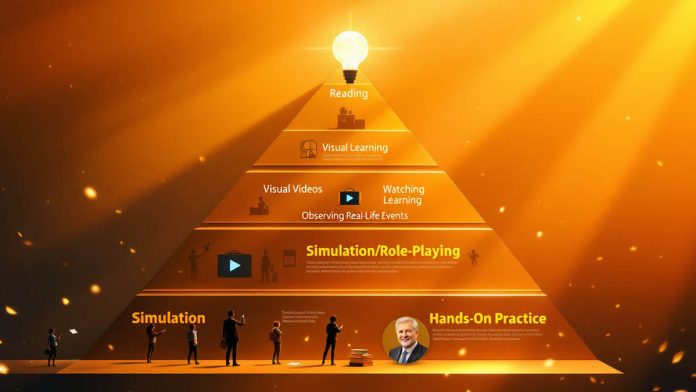
What if there was a simple way to remember more of what you learn? That’s exactly what Edgar Dale, a renowned American educator and professor at Ohio State University, proposed back in 1946. His “Cone of Experience”, better known today as the Learning Pyramid, is a visual model that suggests how people retain knowledge better depending on the learning method used. And while it’s sparked debates among experts, it remains a popular tool for teachers, students, and lifelong learners aiming to retain information more effectively.
Who Was Edgar Dale?
Edgar Dale was a pioneer in educational theory who believed that how we learn affects how well we remember. In his book Audiovisual Methods in Teaching, he introduced the “Cone of Experience”—a metaphorical framework that ranked learning experiences from the most abstract (like reading) to the most concrete (like hands-on practice). The core idea: the more active the learning, the better the retention.
Understanding the Learning Pyramid
Though Dale never included exact percentages in his original work, later adaptations added numbers showing how much we retain depending on how we learn. Whether or not the percentages are precise, the message is clear: active learning beats passive absorption.
Here’s a breakdown of the Learning Pyramid’s main levels:
- Reading or Lectures: The most abstract level—reading textbooks or listening to lectures results in the lowest retention.
- Visual Learning: Seeing images, diagrams, and infographics can improve understanding, but it’s still largely passive.
- Watching Videos: Adding motion and audio increases engagement. Think documentaries, educational YouTube videos, or recorded experiments.
- Observing Real-Life Events: Watching actual events—like a science demo or a historical reenactment—brings knowledge closer to experience.
- Simulation and Role-Playing: Practicing in a controlled, safe setting—like debate clubs or mock trials—bridges theory and application.
- Hands-On Practice: Doing the task yourself, whether it’s a chemistry experiment or writing an essay, creates deep, lasting understanding.
Applying the Learning Pyramid in Real Life
Want to test this out for yourself? Let’s say you’re studying “The Era of Palace Coups in Russia.”
- Start by reading a textbook chapter on the subject.
- Listen to a podcast or an audio lecture from a historian.
- Look at visual aids—family trees of the Romanovs, timelines, or artwork from the era.
- Watch a historical documentary or educational video about the Russian monarchy.
- Create a project like a mind map or diorama to process the information more actively.
- Join a discussion in a study group, sharing what you’ve learned and asking questions.
- Give a mini-lecture to friends or family—explain the topic out loud in your own words.
- Reenact a scene from that era or attend a historical reconstruction event for full immersion.
Each layer you add pushes the knowledge deeper into your memory—because you’re going from passive consumption to active engagement.
Addressing the Criticism
It’s important to note that Dale never claimed scientific accuracy behind the exact retention percentages many versions of the pyramid cite today. In fact, studies like The Learning Pyramid: Does It Point Teachers in the Right Direction emphasize that the original cone was a metaphor, not a measured model. Another review in Medical Teacher highlights how unverified data continues to shape teaching methods even without experimental backing.
Still, the core idea behind the cone—that active participation leads to better learning—is widely accepted.
Why Dale’s Model Still Matters
Despite criticism, Dale’s Learning Pyramid remains a powerful tool, especially for educators and students looking to improve their learning efficiency. Here’s why:
- It encourages active learning: More doing, less just listening.
- It helps diversify teaching methods: Teachers can mix lectures, visuals, and hands-on activities for better engagement.
- It supports project-based education: Real-world applications improve retention.
- It simplifies complex ideas: The cone offers a visual way to explain abstract educational concepts.
Conclusion
The Learning Pyramid isn’t perfect—but it’s incredibly useful. By recognizing the power of active, experience-based learning, Edgar Dale gave us a framework that’s still helping students and teachers decades later. Whether you’re prepping for an exam or teaching a new subject, remember: the closer you get to real-life application, the more likely it is you’ll remember it for good.