

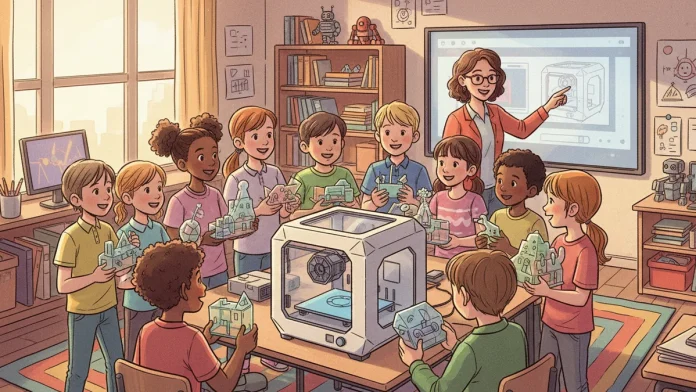
In a lot of schools, the 3D printer is easy to spot. It is usually tucked against a wall, quietly working, while the rest of the class moves on. Students know it is there. They think it is cool. But most of the time, it feels optional. Something extra.
That attitude is starting to shift, mostly because teachers are realizing the printer matters less than what happens around it.
Watch a class using 3D printing properly and you see something different. Students are not staring at screens waiting for instructions. They are leaning over a table, arguing about measurements, holding a half finished object and trying to figure out why it failed. Someone says the design was wrong. Someone else blames the settings. Nobody is asking if this will be on the test.
That is the point.
3D printing forces ideas out of the abstract. A design either works or it does not. There is no hiding behind a clever explanation. When a print collapses halfway through, students feel it. They also want to fix it. That instinct is hard to teach with worksheets.
Teachers often say the most noticeable change is how students react to mistakes. A bad print does not feel like failure in the usual school sense. It feels temporary. Something to adjust and try again. Over time, that changes how students approach other problems too. They become more patient. More willing to experiment. Less afraid of being wrong.
Another thing happens quietly. Subjects stop staying in their lanes. A science project turns into a design challenge. Math shows up in scaling and proportions. Writing sneaks in when students have to explain what they built and why it matters. Nobody announces this as cross curricular learning. It just happens.
This matters right now because classrooms are flooded with technology. Tablets, apps, platforms that promise engagement. Some work. Some burn bright and disappear. Teachers are tired of tools that look impressive but change very little.
3D printing does not look impressive at first glance. Plastic objects are not glamorous. But the process slows students down in a good way. It asks them to think through a problem instead of clicking past it. It rewards persistence more than speed.
There is also something grounding about it. Outside school, engineers and designers use 3D printing to test ideas, not to show off. Students sense that. The work feels closer to real life, even when the project is small or imperfect.
This does not mean every classroom needs a printer. It does mean schools are rethinking what useful technology looks like. Less noise. More depth. Less performance. More problem solving.
As education keeps chasing the next big thing, 3D printing is quietly doing something else. It gives students time to struggle, adjust, and try again. And in a classroom full of instant answers, that might be its real advantage.