

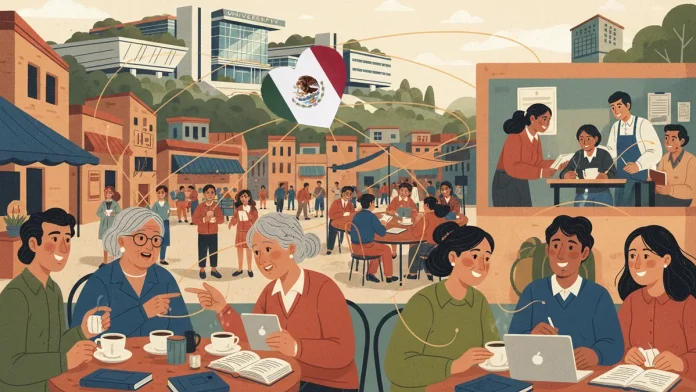
Mexico is trying to change the way people think about learning that lasts a lifetime. This time it actually seems like it is going to happen. Mexico wants to make learning something that people do their lives not just when they are, in school. The country of Mexico is really working to make this idea of learning a reality and it feels like they are taking it seriously this time. Mexico is making an effort to redefine what lifelong learning means to them.
There is a change in the way Mexican universities are talking about education. It is not a deal or anything.. You can tell something is different. They do not give many speeches about how great they are or where they rank. Now Mexican universities have talks, about adults who have jobs and are struggling to keep up. Mexican universities are discussing education for people who are already working and slowly falling behind.
Week Tecnológico de Monterrey made a deal with UNESCOs Institute for Lifelong Learning that will last for four years. At first this sounds like another deal with a group, from another country.. When you think about it it seems like Tecnológico de Monterrey is trying to change the way colleges and universities work in Latin America.
Tec is not starting from scratch. The university already has about 200,000 people who are learning all their lives. People who are studying outside the university courses. A lot of these people are older. A lot of them are working. Some of these people never thought they would go back, to school. They felt like they had to. Their jobs changed on them. The skills they knew became old. The job market moved on. Tec has a lot of learners. Many of these learners are older people who are working.
UNESCO is really interested in cities. You see, most people in Latin America live in cities than 80% of them.
Learning in these cities can be a bit over the place. People do not have a lot of time to learn they have to do it in bits like when they are taking a break from work or using their phone.
They even learn things from their job. The way people used to think about education, where you had to stop everything to learn just does not work anymore.
UNESCO has been creating something called “learning cities” for a time and the way Tec does things fits in with that idea really well. UNESCO and learning cities are a match, for Tec.
Inside the university people feel like they do not have a lot of time. Michael Fung, who is in charge of Tecs Institute for the Future of Education does not talk about changes happening all of a sudden. Instead Michael Fung talks about how some people’re being left out. He thinks that the way education works is still made for a kind of student. This student is usually young goes to school all the time and has money to support themselves. The education system is not made for anyone. So people who are not like this have to either fit in. They will not be able to continue their education. Michael Fung and the Institute, for the Future of Education are working on the education systems. The education systems need to change to include everyone, not a certain type of student.
Mexicos position makes this pressure sharper. The country has a lot of people and a strong informal economy where many people work. Many people in Mexico work without knowing what their next job will be or how to get better at what they do. Technology is changing the way people do things quickly. Schools and other places that teach people things are not changing fast enough. When people do not get the chance to learn things it makes a big difference in Mexico, between people who have a lot and people who do not have much and this happens very quietly.
Tec does not promise that it has the one answer to everything. What Tec wants to do is bring people. One of the things Tec is doing is helping universities in Latin America. Tec wants to help up to 1,000 universities, in Latin America by the year 2035. The idea Tec has is not complicated. It is a big goal: help universities see where they are give them useful things to help them and let them learn from other universities that are dealing with the same problems. Not every university needs to do things the way. A lot of universities just need a help to get started with Tec. Tec is trying to support these universities with its initiatives.
People talk about skills being a problem. Many employers, in this area say that graduates have a time using what they learned. The universities say that they do not have money and that companies do not help them enough. Tec is trying to find a ground by working with the government and companies to figure out what the region needs and then build training programs around that. Nobody knows for sure where the money will come from. Everyone knows that. They are asking development banks and foundations for help. There is still a big gap.
What makes this effort feel different is the way it sounds. People are not saying we have to be like Silicon Valley or Europe. They are saying Latin America can make its way, based on what Latin America needs. The projects that Tec is doing are really varied. They are doing research with companies. They are also doing small learning programs for people who cannot take time off from work not even for a little while. Latin America is trying to build its models and that is what makes this effort feel different. Tec is really focused, on making things work for Latin America.
There is also a sense of urgency. Speakers at Tecs education conference kept talking about the same fear: that countries who do not move fast enough will end up using education models that other countries have created instead of making their own education models. This is not something to worry about in theory. It is, about things that affect peoples lives, like jobs, wages and what happens to people who do not have the right skills when things change. The education models are a deal because they affect peoples jobs and wages and who gets left behind when skills change and new education models are used.
Nothing can really make sure that something works out. Universities are very slow when it comes to making changes. It is hard to get people to work together in areas. The thing is, you can never have money.. I have seen that people are starting to move away from just talking about learning throughout your life as a concept and they are actually starting to think of lifelong learning as something that needs to be set up and supported, like a system or a network, which is a big change from just talking about lifelong learning, as an idea.
For Mexico, and possibly for the region, this is less about ambition and more about necessity. Education is no longer something that happens once. And the systems built for another era are starting to show it.