

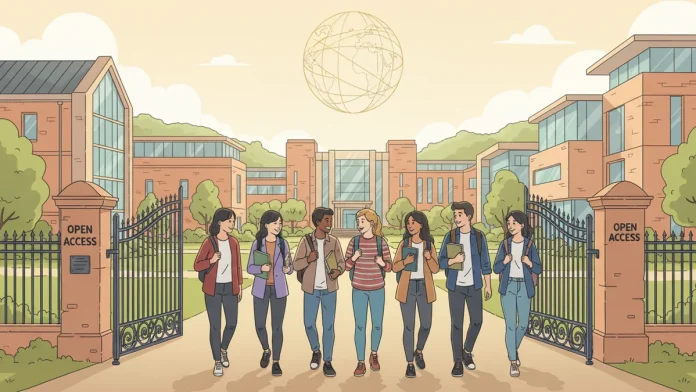
Can universities really make migrant students feel at home? Is it possible for universities to do more, than welcome migrant students? What can universities do to help migrant students settle in and feel like they belong? Universities have to do a lot of things to integrate students.
Muleka Ilunga talks about running from the Democratic Republic of Congo when he was a kid. He does not think about the rules and laws. Muleka Ilunga remembers the back of a truck. Muleka Ilunga remembers crying and calling out for his mother. This picture stayed in his mind for a long time after Muleka Ilunga got to South Africa.
Today he is a masters student in sport science at the University of the Western Cape and he works with Cape Town City Football Club. When he is on the field the refugee label does not matter to him. In the classroom sport science education feels more steady than anything that war could take away from him. The story of the University of the Western Cape masters student in sport science is the kind of story that universities like to tell people. It shows that sport science education and opportunity really do work for the masters student, in sport science.
UNESCO is asking a tough question: what about all the other people out there what happens to them what about everyone else?
In January the organization came out with a report that anyone can read called More than Welcome. This report says that colleges and universities need to think about how they help migrant and refugee students. The numbers are really bad. By the end of 2024 than 123 million people had to leave their homes and move somewhere else.. Migrant and refugee students are not doing well in school. About 7% of refugee students make it to college. At the time the global average enrollment rate for all students is, above 40%. This is a difference and it shows that migrant and refugee students need more help to get into college just like the report More than Welcome is saying.
The gap is not subtle.
Universities usually talk about scholarships orientation sessions or counseling services for students. These are things to do.. The report says that these things can be just a way to make it look like the university is being inclusive. The problem is that the university culture does not really change. Migrant students have to fit in with the university. The university does not change to fit their needs. This means that integration is not really working because it is the migrant students who are doing the adapting. The university is not adapting to help students.
You can see this tension on college campuses. For example in Birmingham, which’s one of the most diverse cities in the United Kingdom, the University of Birmingham has created special help for refugee students. This help is part of a program to make everyone feel included. The people in charge of the university talk about the time they meet with a student, which they call the “front door” moment. This is when they talk about things like money and immigration status. If this first meeting does not go well the student might get discouraged and not continue. The university also does things to help like matching students, with peers who can guide them providing support that understands what trauma can do to a person and giving clear advice so students do not have to keep retelling their difficult stories over and over again at different offices.
This idea seems like it could work. However it is also very costly. The fact that there are funding problems and the rules for immigration are changing all the time makes things very difficult. One person who is in charge of a university said that the problem is not that people do not want to help the problem is the systems that’re, in place. The systems are the issue, not the goodwill of the people the goodwill is there. The systems are what are causing the problems.
UNESCOs report says that integration should be a two way thing. Migrant students do not just get help they also change the classrooms, the conversations and what people are studying. In countries, where most people who have been displaced actually live universities often have less money but they have a lot of experience with different kinds of people. Integration in these places can happen naturally as part of life rather than being a special program. Migrant students and integration are very important, for universities and integration is a part of what migrant students do.
Campuses are really a part of the world we live in. The fact that some people do not want others to move to their country is an issue. This problem does not stop when you get to the university. Rooms where teachers give lectures can be places where people get upset with each other just like they can be places where people talk things through and understand each other. Campuses and lecture halls can have a lot of tension. They can also be places where people have good conversations and learn from each other like campuses and universities, in general.
Ilunga and other students who have been through this say that getting a scholarship is not the thing that helps. They need people to guide them a community that cares and places where they can be themselves without feeling like their identity’s a problem. These things are just as important as getting help to pay for school. Ilunga and other students really think that mentorship and community are crucial, like the scholarships they receive. Ilunga and other students believe that having spaces where they can be themselves is vital.
Universities like to see themselves as engines of mobility. UNESCO seems to be suggesting they are something else as well: testing grounds for how societies live together. Whether they are ready to change as much as they ask their students to change is another question. And one that may define not just campus life, but the kind of public life their graduates eventually carry into the world.