

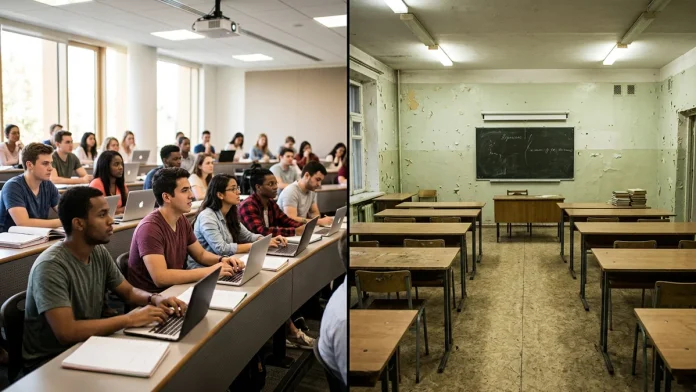
103 million students were in higher education worldwide in 2000. By 2024 that number hit 269 million—a jump of 161%. UNESCO’s monitoring report frames this as going “from privilege for the elite to mass participation.” The phrasing does work there. Mass and equal aren’t interchangeable.
China’s numbers tell the story. In 1999, China’s gross enrollment ratio sat at 7%. Last year it was 77%. Forty-eight million university students. More people than Algeria has. Beijing’s been approving new schools—58 of them recently, vocational mostly, and planted two-thirds in central and western provinces away from the coast. From 2006 through 2013, a Beijing kid’s odds at Tsinghua were 30 times higher than someone’s from Henan—literally the next province over. The Gaokao pass rate climbed to 90% by 2020. Started at 20%. Elite university doors stayed stuck.
Liu Yanjing grew up poor in Shaanxi Province. The classrooms were bad. Her teachers tried. Tutoring wasn’t affordable. The National Special Admissions Program reserved seats for students from disadvantaged regions—villages, small towns—using a modified evaluation. Gaokao scores still mattered, just weighted differently. She got in. She wrote for UNESCO that “targeted public policy can make a real difference.” The program cracked open doors that looked shut. Except it exists as a program because those doors don’t swing open naturally.
Chile’s another case entirely. Reformed the system in the 1980s using US market principles. Student loans at scale funded expansion from 25 universities to 132 institutions counting professional institutes and technical centers. Enrollment ratio jumped from 25% to 110%. Debt followed predictably. Rich families clustered in elite schools. In 2016 they tried fixing it—free tuition for the bottom 60% of households by income. Access went up. The sorting mechanisms persisted. First-generation students and poor kids get shunted toward less-selective institutions. Technical programs mostly. The freshman dropout rate: 14%. Another 14% graduate on schedule. Thirty-eight percent finish a year late, 60% take three extra years.
Noah Sobe runs Higher Education at UNESCO. His take: “Access is not a sufficient measure.” Graduation rates rose about 10% across 25 years. Europe and North America lead that metric. Asia caught up almost completely. Sub-Saharan Africa lags way behind. “We need better measures and the ability to look at attainment among age groups,” he told reporters.
Fiji’s got 937,300 people spread across 110 inhabited islands. Government pays 70% of student costs. The National Toppers Scholarship covers everything—tuition, living expenses—for STEM students whether they stay in Fiji or go abroad. Loan repayments cap at 20% of post-graduation income. Seventy percent of high school grads continue to university. Enrollment ratio went from 14% in 2005 to 75% now. The University of the South Pacific built its own satellite network to connect the islands. Internet infrastructure costs still choke expansion.
Ten years ago Saudi Arabia had eight universities. Now it’s got 70 public and private institutions, oil wealth driving the build-out. Seven landed in underserved regions. The expansion included community colleges and women’s colleges. King Fahd University of Petroleum and Minerals made 67th place globally. The kingdom’s got one scholarship that puts 50,000 students in foreign universities. There’s a separate platform for studying domestically—pulled a quarter million applications. At Saudi Electronic University, female students doubled between 2018 and 2024.
Population’s 35 million. Guest workers and families account for 44%. University’s free for them like it is for Saudis. Completion rates split sharply though: 65% of nationals finish degrees, 35% of non-Saudis.
The report runs heavy on statistics—enrollment trends, international comparisons, regional breakdowns. Meanwhile 273 million children are out of school globally, which is 60 million more than Brazil’s entire population. That number’s been rising for seven straight years. Progress stalled in every region after 2015.
Enrollment climbs. Who graduates, who benefits, who gets sorted into which tier—none of that’s resolved.