

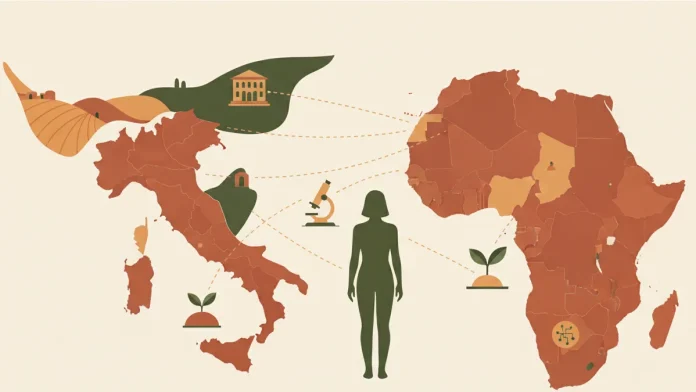
Enrico Mattei didn’t die quietly. The plane went down in 1962 — sabotage, most people who’ve studied it believe — because he’d been negotiating with oil-producing nations on terms that gave them an actual share of the money. European rivals didn’t love that. Italy named its Africa plan after him. Whether that choice reflects genuine inheritance or just good branding is worth keeping in mind while reading what the plan actually does.
Two years in, the Mattei Plan has moved from announcement to construction. Education sits somewhere near the front of it — not always the loudest element, but present enough that Meloni, speaking in Addis Ababa in February at a summit held on African soil for the first time, spent considerable time on it. Her phrasing was deliberate. No new dependencies. Empowerment. Cooperation built from dialogue rather than imposed from above. The words were chosen carefully, which is itself information.
Concrete things are happening. Outside Sidi-Bel-Abbès in Algeria, an agricultural research center carrying Mattei’s name is being developed — aimed at food security, technology transfer, regional collaboration. In Cairo, an AI training and development hub is taking shape, connected to the African Union’s continental AI strategy, with fourteen countries formally involved. These aren’t placeholder initiatives. Funding is moving.
Mohamed Hassan, a Sudanese scientist who spent years running the World Academy of Sciences, sees the framework as genuinely useful — if expanded. His concern isn’t with the centers being built but with the geography of ambition. The plan concentrates heavily on North Africa and a handful of coastal economies. Sub-Saharan universities, particularly in the least developed countries, get far less attention. Regional hubs are fine, he suggests, but they can also become places where a small research elite circulates without the knowledge going anywhere broader.
Naji, who spent years advising Morocco’s higher education ministry before moving to independent research, is more direct about the structural logic underneath the partnerships. African scientists and future policymakers, trained in Italian institutions, working with Italian technology, building careers inside networks that run through Rome — that’s not an accident of geography. It’s how influence compounds over time. Italy placed ninth in the 2026 global soft power rankings, built partly on exactly this kind of reach.
Walk through any Italian university town with a significant international population — Bologna, Trieste, Rome — and the African student presence has been quietly growing for years. Moroccan postgraduates, Egyptian engineers, Cameroonian researchers. The last time anyone counted properly, around 2021-22, the number sat near 16,000, up more than half from six years earlier. The Mattei scholarships will push things further in that direction. What happens after the degree — whether people go back, whether anything useful is waiting when they do — that part of the story tends not to make the summits.
Harris Andoh, who evaluates higher education policy in Ghana, names the gap directly. African universities are struggling with something the Mattei Plan doesn’t particularly address: graduates who complete degrees without gaining skills that connect to actual work, systems where the link between university training and employment has been broken for a long time. A joint doctoral programme in Trieste doesn’t fix that. It might even pull the people best positioned to fix it further away.
Meloni has promised her electorate a reduction in migration from Africa. Investing in African prosperity is partly a domestic political bet. Whether that makes the education partnerships more or less trustworthy probably depends on whether the investment outlasts the electoral cycle.