

First week of school. A child arrives home with something new in her backpack. Nobody sent instructions for that part. The note from the district explains the charging requirement. It doesn’t explain much else.
Please charge overnight. What nobody specified was what would happen between the charging and the morning.
That was a decade ago. The question of what actually happened is now reaching legislators.
By last school year, personal devices had become standard equipment in almost every public school in the country. Covid compressed everything. Hardware decisions that would have taken a full budget cycle got pushed through in weeks. Federal money was available, remote learning was non-negotiable, and the longer questions — about what happens when the emergency ends and the devices stay — were nobody’s immediate problem. They became everyone’s problem later.
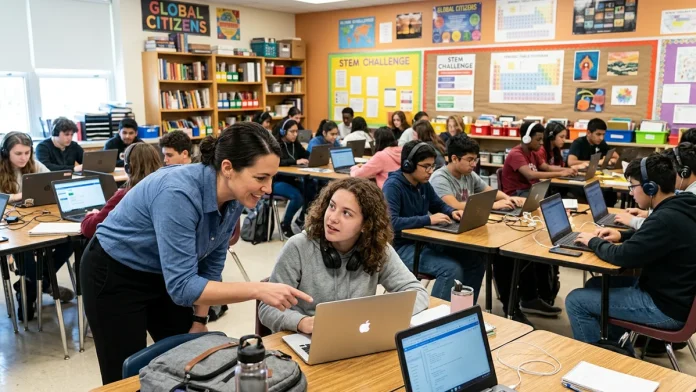
Research on the effects of personal devices in classrooms remains surprisingly thin. What is clearer is the distraction data. A recent study found teachers estimate roughly one in three students used laptops during class for purposes unrelated to learning — social media, texting, in some cases streaming video while maintaining enough apparent engagement to avoid detection. Phones, at least, are visibly phones. A laptop with the wrong tab open looks identical to one being used correctly.
Phone bans have been one of the rare bipartisan education policy wins of recent years. Roughly nine states have now introduced some form of device-limiting legislation. Advocates pushing for restrictions are careful about how they frame it. Removing technology from schools entirely isn’t what they’re after — the target is narrower, focused on usage that clearly isn’t serving students. That framing gets lost in the coverage, which tends toward the simpler story. Skills like typing, navigating digital tools, basic spreadsheet literacy — nobody serious is arguing those don’t belong in schools. The argument is about whether every subject needs to be taught through a screen.
What makes edtech harder to regulate than phones is that edtech, used well, genuinely works. The evidence for older students is reasonably solid. For younger students it’s considerably weaker. And the communities most exposed to any rollback are often the ones that went furthest in. Districts serving lower-income populations leaned hard on grants and federal funding to get devices into classrooms — money that came attached to optimistic projections about learning outcomes. Asking those districts to scale back now means sitting with the distance between what the technology promised and what the data actually shows.
Data privacy sits underneath all of this without resolution. The edtech industry holds vast quantities of student information. Whether it’s being managed to adequate standards, who is verifying that, and what recourse exists — the answers remain vague. One researcher put it plainly: asking companies to self-certify their own products’ safety is structurally similar to letting tobacco companies vet cigarettes.
There are also students for whom device access isn’t a convenience but a necessity. Learners with disabilities and students with different learning needs depend on assistive technology in ways a sweeping ban would simply eliminate. Any policy that doesn’t account for that population isn’t finished.
For parents trying to navigate this without waiting for legislation to catch up, the entry points are smaller than they might seem. Asking a school directly which edtech products are in use — and whether any third party has evaluated them — is a reasonable question that most administrators aren’t currently being asked. Checking whether the district has a clear policy on non-academic device use during class takes one email. The conversation with a child about what the laptop is actually for during school hours doesn’t require any policy change at all.
None of that resolves the structural problem. But the structural problem will take years. The child is in school now.