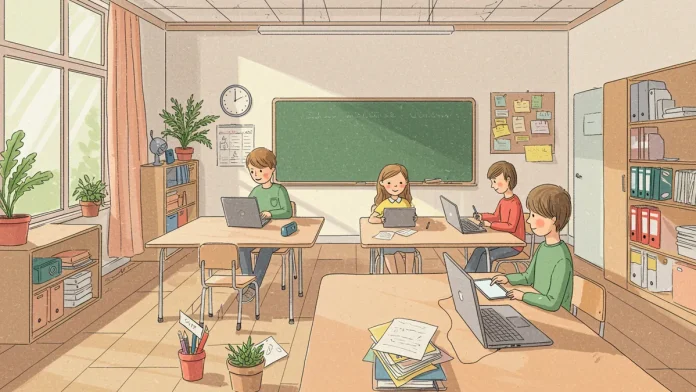
Walk into a classroom today and the change isn’t dramatic. There’s no sci-fi feel, no wall of blinking devices. What you notice instead is what’s missing. Fewer stacks of worksheets. Fewer textbooks weighing down backpacks. In their place, a quiet mix of laptops, shared documents, and students toggling between discussion and screens. This is what educational technology looks like on the ground now. Practical. Uneven. And increasingly tied to how schools think about sustainability.
Teachers talk about it in everyday terms. One high school teacher in the Midwest described how she stopped printing weekly reading packets last year. Students now access everything online, annotate together, and submit work digitally. The lesson didn’t change much. Her prep time did. So did the recycling bin. Small shift, noticeable impact.
Across schools, similar adjustments are adding up. Digital textbooks are becoming the default, not because they’re flashy, but because replacing damaged books every year was draining budgets. Virtual labs are filling gaps where equipment is outdated or too costly to replace. A biology class can now run simulations without burning through disposable materials. Students still debate results. They still make mistakes. Just with fewer physical resources consumed along the way.
Learning itself is moving differently, too. Some teachers record short lessons for students to watch at home. Not every student watches them on time. That’s the reality. But when it works, class time opens up. More discussion. More problem-solving. Less standing at the front talking at tired faces. It’s a subtle change, but students notice when the room feels more active.
Games have crept into lessons as well. Not because schools want to turn everything into entertainment, but because participation rises when students feel involved. A quiz on a screen replaces paper tests that used to take hours to grade. Feedback comes faster. Teachers adjust sooner. The paper savings are obvious, but the bigger shift is momentum.
Still, the transition isn’t smooth for everyone. Some teachers embrace new tools quickly. Others hesitate, worried about tech failures or losing structure. Schools that struggle often push too hard, too fast. The ones making progress tend to offer support without pressure. Peer workshops. Shared lesson ideas. Time to experiment without being judged.
Students experience the difference in small moments. A shared project they can update from home. A missed day that doesn’t mean falling behind. A science experiment repeated safely until it makes sense. At the same time, screen fatigue is real. Many teachers deliberately pull back, balancing digital work with hands-on tasks and conversation.
What’s happening now isn’t a revolution. It’s a recalibration. Schools are learning where technology actually helps and where it doesn’t. Sustainability plays a role, but rarely as a slogan. It shows up as saved money, lighter backpacks, and fewer late nights at the copier.
The bigger question hangs quietly in the background. As classrooms rely less on physical materials and more on shared digital space, what kind of learning culture will that create over time? The answer isn’t clear yet. But the direction feels steady. Less waste. More flexibility. And classrooms that look a little closer to how the world outside already works.