

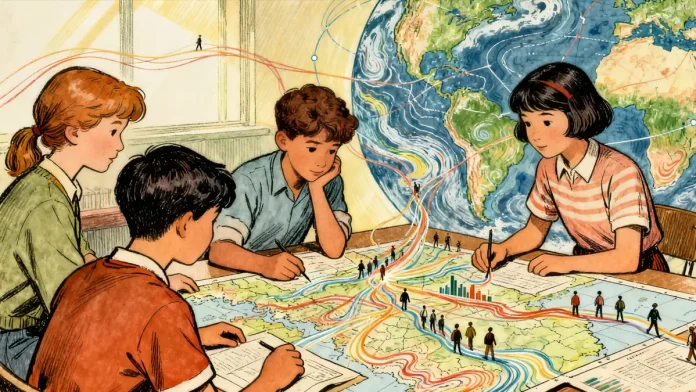
In a world defined by climate disruption, technological acceleration, and rapidly shifting global systems, geography has re-emerged as one of the most powerful tools for understanding our future. Far from being the middle-school memory of capitals and flags, geography has transformed into a discipline of systems, power, and possibility. And as educators rethink what students need to navigate a volatile world, a surprising truth is becoming clearer: geography may be the curriculum we’ve been missing.
Many students enter introductory courses expecting map memorization. But once they begin exploring climate migration, colonial borders, supply chains, or digital surveillance, something shifts. They stop seeing dots on maps and start seeing networks of decisions, inequalities, and opportunities for change. In those moments, geography becomes more than a subject—it becomes a lens for understanding how the world actually works.
Today’s students live in a world shaped by infrastructure, borders, algorithms, environmental risk, and global markets. Whether they become engineers, business leaders, policy designers, or innovators, they are already embedded in systems that geography explains with striking clarity. Geography answers not only where things happen, but why they unfold the way they do—and how they could be redesigned.
At its most transformative, geography exposes how global issues intertwine. It reveals that climate change impacts communities unevenly, that supply chains depend on unseen labor across continents, and that disasters labeled “natural” are often the product of decades of policy and neglect. In other words, geography makes injustice visible. And once students notice these patterns, they never unsee them.
Effective geography education goes beyond theory. Students build StoryMaps of food deserts, assess wildfire evacuation routes, and create systems diagrams tracing the life cycle of everyday objects. They even help shape ethical AI policies, linking their learning to real-world technological dilemmas such as privacy, labor, and algorithmic bias. Through these experiences, geography becomes a toolkit that integrates their identities, majors, and futures.
But content isn’t the only transformation—classrooms themselves are shifting. Large lectures become communities through collaborative response systems. Anonymous discussion boards provide a safe space for students to surface uncertainties and shape the pace of learning. AI tools become inquiry partners rather than shortcuts. With each innovation, students become co-creators of knowledge, not passive recipients.
This approach contrasts sharply with many top-down AI initiatives across universities, which often overlook faculty input and add burdens instead of support. By treating geography as a participatory, interdisciplinary, justice-focused framework, educators demonstrate what future-ready curriculum should look like.
As the world faces intersecting crises—misinformation, climate instability, geopolitical tension—students need new cognitive tools. They must be able to hold complexity, think spatially, understand systems, and act ethically. Geography delivers all of that in one discipline, bridging science, policy, technology, climate, culture, and human behavior.
It’s no longer just a subject. It’s a strategy.
Conclusion: Geography is a lens, a method, and a mindset. It empowers students to understand their world with clarity and to reshape it with purpose. As one student discovered, once you learn to see systems, you can imagine—and build—something better. Geography may not just be the curriculum students need; it may be the curriculum the future demands.