

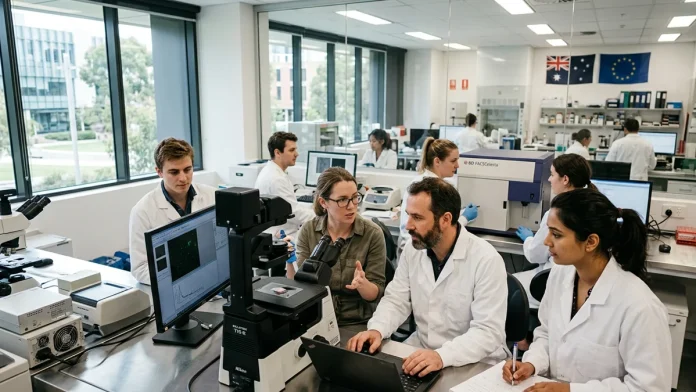
Australia’s been negotiating access to Horizon Europe for over a decade. Albanese just announced they’re going in.
The country will begin formal talks to join as an associate member—not observer status, not third-country participation with restrictions, but full operational access to the €95.5 billion research framework. The current program runs through 2027. A successor’s being discussed at €175 billion. Get in now, Australian researchers compete on equal terms in the next cycle. Miss it, and they’re outside for another seven-year stretch.
What associate membership actually delivers: Australian universities can lead multinational consortia, not just participate. They can help set research priorities instead of reacting to them. They apply for funding under the same rules as institutions in France or Germany. Right now Australia’s classified as a “third country.” Participation happens, but through narrow channels. The UK left the EU and joined Horizon Europe anyway. New Zealand’s in. Canada, South Korea, Japan. India’s weighing it.
Luke Sheehy runs Universities Australia. He’s been arguing for this since before the current program launched. The pitch he’s making now emphasizes breadth—every institution has research strengths that map to Horizon priorities, not just the Group of Eight heavyweights. Ocean systems science, reef ecology, agricultural sustainability, criminology, public policy. Those capabilities sit in regional universities as much as Sydney or Melbourne.
Horizon Europe operates through large cross-border consortia tackling defined challenges. You don’t submit solo proposals. The model inherently pulls in multiple institutions, which Sheehy argues creates space for universities outside the usual suspects.
Vicki Thomson from the Go8 frames it differently. Australian researchers already compete globally, she says. The disadvantage is structural, not about capability. “At present, our peers are embedded by default. Australian researchers are not.” Horizon funding is oversubscribed. Success rates stay low. Applications demand coordination across borders and strong institutional backing. Starting from outside compounds every barrier.
There’s a geopolitical layer here that nobody’s saying out loud but everyone’s thinking. Research collaboration increasingly tracks with supply chain security, technology access, trust networks. Thomson mentioned Australia’s Indo-Pacific position brings “perspectives increasingly valued” in global research. The Horizon talks are also tied to reviving a stalled Australia-EU trade agreement. Science funding and market access aren’t happening in separate rooms anymore.
The program funds university-business partnerships outright. Technology commercialization, market development, actual product launches. Clean energy companies in Australia could use it as a route into European chains. Biotech firms too. Advanced manufacturing operations.
Associate members pay in proportion to expected participation. Cost questions surface fast when budgets are tight. Sheehy pointed to a bigger obstacle than money: “Too often, research is treated as a ‘nice to have’ rather than what it actually is—a core economic driver.” Governments hunting for savings see research as discretionary spending. He thinks that’s backward.
The negotiation timeline is compressed. To join the 2027 cycle, Australia needs finalized terms with the European Commission soon—contribution formulas, governance rights, program rules. New Zealand’s participation offers a template, but every associate country negotiates separately.
On timing, Sheehy was blunt: “If we want Australian researchers and industries to be part of Horizon Europe from 2027, decisions need to be locked in now.” Albanese made the announcement. Negotiations start from here.
Whether Australia can navigate the actual competition once inside, justify the costs domestically, and ensure regional institutions benefit alongside the elites—all of that’s still unsettled. The door opened. Walking through it is different work.