

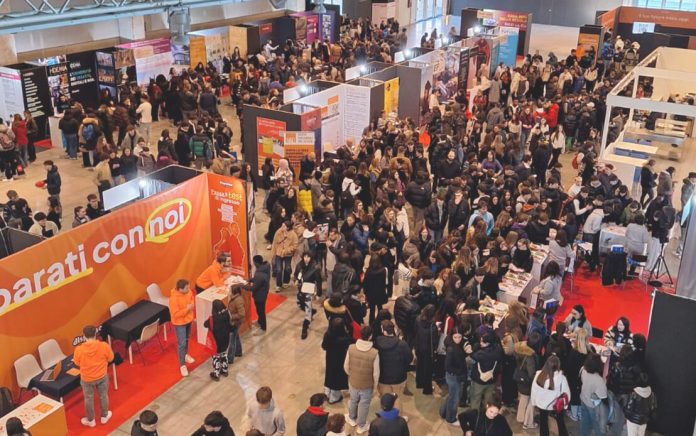
Parma becomes, for two days, a crossroads of questions and opportunities: those of students looking beyond high school, and those of universities, ITS institutes, training bodies, and education providers working to build a stronger bridge between school and the labour market. At Fiera di Parma on 18–19 February 2026 (9:00 a.m.–1:30 p.m.), the Student Fair (Salone dello Studente), a stop on the national Campus tour, provides young people with practical support to make more inforned choices about their next steps.
Here, guidance is not a slogan, it is an experience shaped by talks, workshops, and direct conversations with those who live higher education and the professions every day. Participation is free , but registration is required via the CampusHub app, which also enables attendance verification.
One of the fair’s most relevant aspects is its measurable educational value: attending provides 5 hours per day that can be recognised and used for PCTO (Italy’s Pathways for Transversal Skills and Guidance). Accessibility also matters : the sessions are streamed online, so schools and classes that cannot attend in person can still take part.
In this sense, the fair is a cultural tool as much as an informational one: it stages the most important question “who do I want to become?” and connects it to concrete realities: “where can I train?” , “Which skills are actually needed?” According to organisers’ information and media coverage, the event brings together education providers and structured guidance activities, with a clear focus on work and training.
The 2026 added value : a Blockchain Digital Badge powered by LutinX
At the end of the two days, all participants will receive a Blockchain Digital Badge issued using LutinX technology. This recognition does more than confirm attendance; it aims to enhance the experience through a skills_oriented perspective. Specifically, LutinX badges:
Certify student participation; recognition is also useful for PCTO purposes.
Offer a strategic instrument for skills recognition and enhancement, aligned with European standards, including the DigCompEdu framework (the European reference for educators’ digital competemces). Provide identity verification for both the badge recipient and the issuing organisation to increase reliability and real-world usability.
In an era when guidance can risk becoming a simple list of options, Parma proposes a different model: a place where information, culture, and personal future meet. And where, alongside dialogue with universities and professions, students leave with a verifiable digital trace of what they did and learned, not to collect certificates, but to build a clearer, more recognisable pathway.