

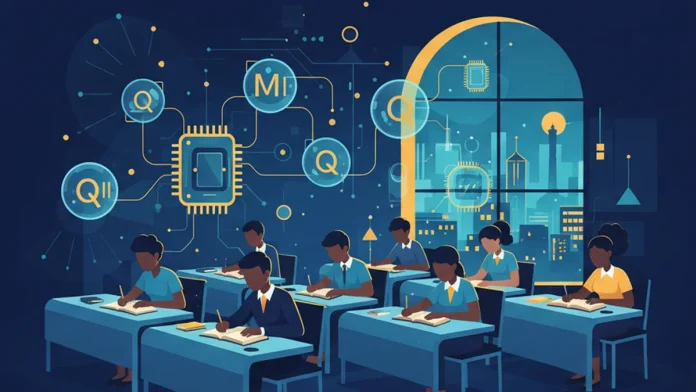
It was an evening in Accra and people were talking about qubits. Not about money problems or elections or even football. Just qubits.
Some important people from Imperial College London and the African Institute for Mathematical Sciences got together. Told students and teachers that Africa needs to get into quantum science. They said Africa cannot just sit back and watch while others do all the work.
Peter Haynes from Imperial College London said something simple. He said that quantum science is already being used in things like smartphones and medical devices.. Now we are moving to quantum computing which uses qubits instead of bits. This is not something from a science fiction movie. It is real.
There are some numbers being talked about. By 2030 there could be a quarter of a million jobs in quantum science.. By 2035 that number could be over 800,000. Now most of these jobs are in the United States, Europe, China and Japan. This is because these places already have the money, labs and people to do this kind of work.
The problem is that Africa might just be a user of these technologies, not a creator.
In universities all over Africa students are really interested in this. Students in Ghana, Nigeria, Kenya and South Africa are very good at mathematics and physics. The African Institute for Mathematical Sciences is known for teaching sciences in a very rigorous way.. Imperial College London has opened a new center in Accra which shows that they think Africa is a good place to invest in.
However the reality in classrooms is not the same. Dorcas Attuabea Addo, a mathematics teacher in Winneba said it clearly. Quantum science is barely taught in schools in Ghana.. Even in universities it is not taught consistently. Some universities teach it in physics classes but others do not teach it at all.
Another problem is that we do not have the infrastructure. It is not about having expensive quantum equipment. We need internet, computer labs, trained teachers and updated syllabi. Students can learn about quantum science using tools but they need someone to guide them. They need teachers who’re confident in teaching this subject.
On the ground this gap is very clear. A student who is interested in quantum computing might have to learn from YouTube videos, foreign textbooks and online forums. Another student might not even hear about quantum science until they go abroad for studies. Meanwhile companies in Europe and North America are already hiring people who know about quantum software.
Peter Haynes said that the gap between Africa and other places in science is not inevitable. He thinks that big companies might eventually look for talent in Africa. Africa has a lot of people and we have shown that we can adopt new technologies very quickly like mobile banking and telecoms.
There are some signs that things are moving. Ghana has a laboratory for optics and photonics supported by SPIE. This is an example of how we can build our capacity in areas related to quantum science. Quantum science can be used in areas like agriculture, water systems, health and climate forecasting. These are not just ideas they are connected to our everyday lives.
Having ambition and actually doing something about it are two different things. It takes time to update our school curricula and train teachers. It takes longer to convince our leaders to invest in quantum science.
For now most of the progress feels like it is driven by partnerships and individual people who care. The students in Accra who were listening to talks about qubits might be the generation to see quantum science as a part of Africas story not just something that happens in other places.
Whether this becomes an opportunity for Africa or not will depend on what happens in our classrooms over the next few years. Quantum science is the key, to Africas future and Africa is trying to get into science.