

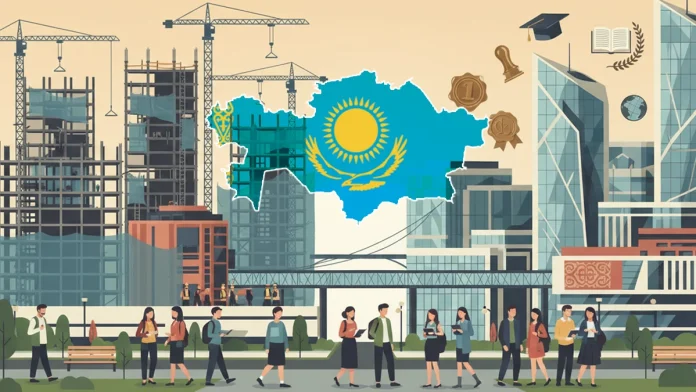
Things are changing at universities in Kazakhstan. The number of universities in Kazakhstan was growing fast. Now this growth is slowing down. The real challenge for universities in Kazakhstan is just starting. Universities in Kazakhstan will have to do a lot of work to keep going and to keep getting better. This is the test for universities, in Kazakhstan.
For the four years higher education in Kazakhstan has been changing really fast. You can see logos from foreign universities on campuses in Astana, Almaty and other places. Universities from Britain, South Korea, Italy and maybe even China and Oxford are coming to Kazakhstan. It was like people were rushing to find gold. Now the education ministry in Kazakhstan is slowing things down a bit. Asking a tough question: what happens to higher education, in Kazakhstan after all the excitement is over?
Sayasat Nurbek, Kazakhstans minister of science and higher education is very straightforward about where the education sector’s right now. For a time the main goal was to make it bigger. Now the focus is on making it better. This is the standard that must be met. Sayasat Nurbek and the ministry of science and higher education are clear that not all schools will be able to meet this standard. The minister of science and higher education is saying that the education sector in Kazakhstan has to change. Sayasat Nurbek wants to see improvement, in the education sector. The minister of science and higher education is drawing a line. Some schools will not be able to cross it.
So many foreign universities, over 36 have set up campuses or centers in Kazakhstan since 2021. Even more are coming. The speed at which this is happening is making people feel really uncomfortable. The faculty at these universities are worried that the standards are going to be watered down. Students are looking at what these universities promised and what they are actually getting. They are not saying much about it. People who are watching this are asking if Kazakhstan is really building universities or if they are just bringing in names like foreign universities. Foreign universities are changing the education scene, in Kazakhstan and people are talking about universities and their role.
Nurbek says that taking a chance was done on purpose. Kazakhstan is a country when it comes to the people who live there. A lot of people in Kazakhstan are really young. Almost half of them are under twenty five years old. At the time things were changing in the world of politics. It became harder for students to get visas to study in countries that they normally would go to. The war, in Ukraine changed where students were going to school. All a sudden Kazakhstan was a place that people could easily get to and it was pretty stable. The ministry of education did things quickly because they were afraid that people would stop thinking about Kazakhstan as a place to study if they did not act fast.
The rush is now and people are starting to feel different. New rules are on the way. The government is asking groups to come and check on schools here. They will look at all universities the ones from here and the ones, from countries and they will have to be very good. Nurbek says that some schools will not be able to keep going when this happens. Nurbek openly accepts that some universities won’t survive the transition. He does not think this is a thing that might happen to them. He thinks it is just what will happen if they are not good enough. Nurbek says it is not something to scare people. It is something that will happen naturally.
This situation is really unsettling when you think about it. Small private universities are paying attention to what is happening because they know that updating the curriculum building new facilities and hiring new faculty members all require a lot of money. The private universities do not all have people waiting to give them money. Some of the universities will have a hard time making these changes. Some private universities will merge with universities or they will disappear and it will not be a big deal. For the students the students who are already going to these private universities the fact that things are uncertain can be very upsetting, to the students.
The government is paying attention to what students are going through not just when they are in class. Kazakhstan has a lot of students, around 35,000 and many of them are from India, Pakistan and China. The goal is to have three times as international students by the end of the decade. However some problems with students in Kyrgyzstan, a country that shares a border with Kazakhstan have made people worried. Nurbek thinks that quality is important because bad education does not just affect the students degrees. It also makes them feel bad, unhappy and angry. Quality matters because international students, like the ones from India, Pakistan and China expect to get an education, in Kazakhstan.
That concern explains why there is a focus on oversight now. Student ombudsmen are being appointed to help with this. They are also making feedback chains more official. There is quiet talk about quotas for international students if the numbers start to overwhelm local systems. This is a reminder that internationalisation of universitiess not just a way to get more students. Internationalisation changes what daily life is like on university campuses and, in the cities where they are located.
People in our country are also wondering about the cost. The government has been very helpful, to universities giving them land, tax breaks and money for a long time. Some people are asking why our local universities do not get the help. The ministry says the reason is that they want universities to be sustainable. There are laws now that let universities create special funds called endowment funds, which are supported by private investors and tax incentives. The idea of the ministry is to make universities stop relying on others and become independent the universities need to have roots so they can move from dependence to having strong roots the universities need to move to sustainability the universities need to have strong roots.
One big problem is still hard to ignore: people. We do not have faculty. We will need thousands teachers in the next few years. The government is asking the people who got the Boloshak scholarship to come home. They went abroad to study. Now the government wants them to return. This is an idea but it is not easy. When the Boloshak scholarship alumni come back it is not, about getting a job. The Boloshak scholarship alumni have to believe in the system that is being built. The Boloshak scholarship alumni have to think that the system is good and will work.
Kazakhstan’s higher education story is entering a quieter phase. Less about announcements, more about follow-through. The country has placed its bet, not just on foreign names, but on the idea that it can compete on quality, not scale alone. Whether that confidence holds will depend on what students experience day to day, long after the ribbon cuttings are forgotten.