

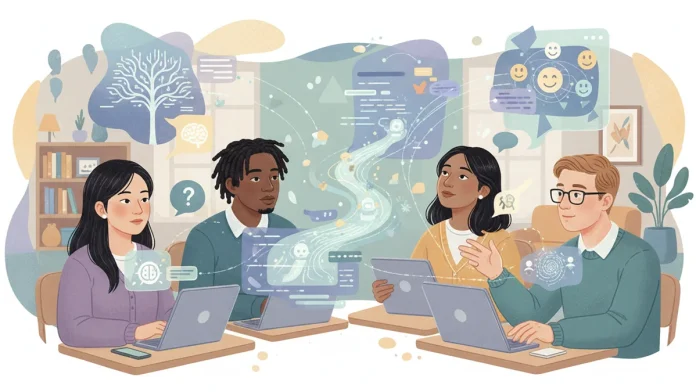
When online education starts I think back to the time when I was in school. Online education is really changing the way people learn. I think about education and how it is becoming more popular. Online education is making it easier for people to get an education. I think back, to what I learned about education and how it is helping people. Online education is the future of learning.
Something subtle is going on in classrooms and most students do not notice online classrooms at first. The change in classrooms does not happen when online classrooms get a new syllabus or a redesigned dashboard. It happens quietly in classrooms in how fast students get feedback in online classrooms how discussions go in online classrooms and how confusion, in online classrooms seems to go away almost too quickly in online classrooms.
For years now artificial intelligence has been changing the way people do research. There are tools like Consensus, Elicit and Scopus AI that have already made a difference in how scholars do literature reviews.
Something that used to take weeks to do like searching and scanning and trying to figure things out can now be done in one afternoon.
Researchers can talk to these intelligence systems try out ideas make their questions better and then move on to the next thing faster.
The part where you have to find the information is not as important anymore.
Now the part where you have to understand what the information means is what matters most. Artificial intelligence is really good, at helping with that.
The same idea is now affecting the way we learn on the internet. We are talking about education. This is what is happening to education.
Students who log into courses today will find that the systems they use are really fast. You can ask a question. Get a helpful explanation right away. If you post a comment you will get some suggestions on how to make it clearer or better organized before anyone else gets to see it. You can even write in your language and it will be translated for the rest of the class.
Platforms like QANDA and Praktika.ai are not just tools anymore. QANDA and Praktika.ai are right, in the middle of the learning process now.
This seems like a thing at first.. It really is, in a lot of ways.
Instructors say they get emails, from students who need things explained again. Students are participating a lot more in class. The quiet students are now speaking up. When it comes to programs the language barriers are not a big problem anymore it happens really fast. A discussion forum that used to be boring and uneven is now full of life. Has a lot of activity.
Having a lot of something really changes how we experience it. The experience is different when there is an abundance of something. This is what abundance does to the experience.
I remember when feedback was something you had to wait for. It would show up sometimes. Times it was really short.. Sometimes it hurt your feelings.. Those times when we had to wait were important. They made students think about what they did. If it was any good. We had to think about what our friends were saying and try to understand them. Now feedback is, around us, all the time. If someone is confused it gets fixed away.
Think about a course that is totally online with students from all, over the world I mean five continents. At the beginning of the term it is really slow to get discussions going. Some students write a lot. It does not really make sense. Others do not say much all. You will notice that a few students are doing all the talking. Then the teacher turns on this system that uses artificial intelligence to help with discussions. Students can write in their language like Korean or Portuguese or German or English. The system translates everything so it is easy to understand. It also points out when someone is not being clear. It helps students to focus on what they’re reading.
Participation really jumps up. This means that the participation jumps. When we talk about participation we see that participation jumps.
Students say they finally feel included.. That is true. Something important has opened up for the students.
After a while the things that students post start to sound pretty much the same. The students do not disagree much as they used to.
The students are able to resolve their misunderstandings before they even have a chance to really think about them.
The classroom becomes a peaceful and organized place, for the students.
This is where the feeling shifts.
Online education is starting to feel like a kind of help service for your brain. When you need help it is there away. The people who are helping you try to make their responses for you. If something is hard to do they try to make it easier they do not want you to have to figure it out on your own. This is good, for the schools because online education can be used by a lot of people at the time. It makes the students happier. It also means the staff do not have to work much. Online education is really changing the way we learn.
But education has never been only about smooth experiences.
Learning happens in the times. The idea that is not fully thought out. The question that is hard to ask. The argument that goes on for a time. When rules and plans take over fast these moments can disappear. Not because someone decided to make them go away. Because the situation slowly stopped letting them happen. Learning often happens in these moments like when we have a half-formed idea or an awkward question or when we have a disagreement that lingers longer than we expected.
What is changing is not the delivery. The way people think and the space where they think, that is what is really changing. The thinking space itself is changing.
Universities have always played a role in shaping how people think. They do this in ways. For example they have rules, for grading. They also have their way of speaking and writing. They teach students what makes an argument. Now Artificial Intelligence is making this influence even stronger. When Artificial Intelligence looks at something a student writes before a teacher even sees it it is already deciding what is okay. What is not. It is telling students what ideasre reasonable what is easy to understand and what risks are worth taking. Universities and Artificial Intelligence are shaping how students think about these things. Artificial Intelligence is helping universities decide what students should and should not do.
As time goes on the students learn what the boundaries are. They figure out what the boundaries of something are. The students learn the boundaries over time.
This does not make Artificial Intelligence hostile, to education. It makes Artificial Intelligence powerful.. Artificial Intelligence needs attention.
Nowadays a lot of institutions still think of intelligence as a tool that helps us. It is something that assists us and something that manages things for us.. When it comes to online education artificial intelligence is becoming a part of the infrastructure. It is, like having electricity or Wi-Fi it is always there. It is rarely questioned. Artificial intelligence is deeply shaping the way we behave when we are using education.
That shift brings questions. Who gets to decide what makes a contribution when machines are giving feedback? What happens to the ways people from cultures argue when everything is translated and made to sound nicer? Which kinds of things are we okay with not having answers to when it comes to contributions and feedback, from the machines and the translation and refinement process of the contributions?
If universities do not ask these questions the design of the platform will answer the questions of the platform instead.
This does not mean we should stop everything or turn off the systems. Students really benefit from being included and having things explained clearly and getting the support they need. Instructors also benefit from having time and being able to focus. The problem is finding a balance. We still need to have places in our courses where students can share their ideas. They can talk about them without someone correcting them right away. We need to allow for silence. We need to be okay with not knowing something. It is okay to show that we do not know. Students and instructors both benefit from courses where the Online Learning System and the classroom work together to help students learn. The Online Learning System and the classroom are both important, for students and instructors.
Faculty roles do not disappear here they actually change. The role of a faculty member is like a traffic cop and more like a steward. A faculty member is someone who watches not what the students say but also how the environment, around them shapes what the students feel is okay to say. Faculty members pay attention to the environment. How it affects what students feel comfortable saying.
When we use tools that help us find information quickly it can really help us think better. This is because we can see how we made our decisions and we have to answer for them. Now we are at a point where we have to decide what to do with learning. It can become so easy that it does not really help us learn.. We can make sure that online learning helps us think for ourselves without telling us what to do. Learning tools can really help us like AI-powered research tools, which showed that faster access, to knowledge can expand human thinking when judgment remains visible and accountable.
The real challenge isn’t whether AI belongs in education. It’s whether universities are ready to take responsibility for how minds are being quietly guided inside their platforms.